
A step-by-step 3-training hack to howling in pets of the Quiet command (to assist with sirens and attention-howling), and a plan of separation anxiety, will be the starting point.
| -Key to know-
•play low music to cover outside distractions. •Reward and praise instantly with a reward. •Bring a ratty T-shirt of yours.
|

They can be trained simultaneously, although, at the beginning, you should have brief and leisurely sessions, so that your dog is not overloaded.
Training the Quiet Command
Training: Train your dog to learn to quit howling.
Step 1: Set Up the Trigger
- A bark/howl can be elicited using a weak trigger (such as a brief recording of a siren or knock).
- Avoid overwhelming–begin at low volume.
Step 2: Mark & Reward the Pause
- Whenever your dog pauses (even after 1-2 seconds) say quietly and firmly, Quiet.
- Reward and praise instantly with a reward.
Step 3: Add Duration
- Wait a longer pause, before gradually saying Quiet and giving the treat.
- Avoid frustration, make sessions short (5-10 mins).
Step 4: Practice in Real Life
- Otherwise, when a real siren or doorbell occurs, call on the same.
- Be cool–by screaming, your dog will think you are screaming with the rest.
Tip:
The treats of high value (small pieces of chicken or cheese) are the best to counteract the excitement.
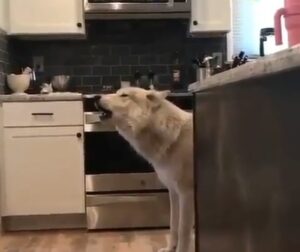
Separation Anxiety Plan
Problem: Teach your dog not to become nervous when alone.
Step 1: Create a Safe Space
- A box (when on the train) or a small bedroom with toys, bed and water.
- Bring a ratty T-shirt of yours.
Step 2: Work on Mini Departures.
- Get out of the room and stand outside the room and come back after 5-10 seconds.
- Still, in small steps, to 1 min, 5 mins, etc.
- Come back quietly (no great welcomes).
Step 3: Establish Good Connotations.
- Only provide special treat or puzzle toy at the point of departure (such as a stuffed Kong).
- Write = Take away when you come back, and hence leaving = good.
Step 4: Add Realistic Sounds
- Play TV or play low music to cover outside distractions.
- Use same routine (keys, shoes) without leaving at times so such cues do not cause panic.
Step 5: Longer Absences
- Slowly stretch to 30+ mins.
- Howling dog, you slowed down–go back and reduce the time.
Extra Tips
- Exercise first: A dog who has used up his energy is less vicious.
- Consistency: The family members are to have a common routine.
- Professional Assistance: In case the anxiety is so extreme (howling at all times, destructive), a veterinarian or a trainer might assist with special programs or calming resources.

timetable you may follow daily.
It reads like a kind of manual that you can follow day in day out with your dog and the Quiet command and separation training is mixed in such a way that it makes it seem natural and fun.
Morning – Calm Beginnings
The day starts softly.
You put the leash on before breakfast and then you walk your dog on a good long brisk walk.
The freshness of the air and the soft breeze takes away part of that morning vigor.
The mind is more apt to learn when fatigued, and your dog goes home rested.
Back indoors you prepare a little dish of training-treats.
Some phone you carried around in your pocket is playing a recording of a siren.
Your dog cocks up, his ears all twitching.
You wait…
Here the howl starts–then halts at one beat of the heart.
You smile, and say Quiet and give a treat.
The round is repeated– brief, quiet, satisfactory.
Five minutes is enough.
You both end on a success.
Late Morning – Mini Departures.
You are about to get ready to say goodbye to the first practice after a play session.
You toss down some toys, say a cheerio.
Then you get out ten seconds.
No dramatic exits.
No sad goodbyes.
Upon the return you just walk in, hang keys up and move on as though nothing had occurred.
Your dog winks, and awaits excitement–but there is none.
The world stays calm.
You say this three or four times, the departures being a little further each time.
Thirty seconds.
One minute.
Two.
Always quiet, always steady.
Any successful homecoming is rewarded by a weak of a good dog and a scratch.
Afternoon – Gaining Confidence.
You get used to Quiet again, when the sun is ascending, with natural stimuli.
A honking car, a bang on the wall.
Every single moment of silence is a victory.
You talk the signal, reward the silence and maintain sessions brief, no more than five minutes or boredom sets in.
You are on another separation drill before evening.
This time you go off five minutes.
The dog is kept entertained by a stuffed Kong which has peanut butter and you slip outside quietly.
You see no howling when you come back, it means that the training is being effective.
Evening – Winding Down
Then there is a last walk and dinner and the house is silent.
You put on low music and get into a relaxing routine.
Drones no longer need exercises–just comfort and company.
Your dog snugs up beside you, weary but happy, and is taught that quiet and peace give the most reward of all things.
Key Rhythm to Repeat
- Morning: Exercise- Quiet practice (5-10 mins).
- Midday: Brief play – Mini departures (progressively more and more).
- Afternoon: Practice with the actual sounds in silence – Longer leaving.
- Evening: Let go and calm down.

The trend is becoming customary with every day.
And your dog starts to know:
“Quiet earns rewards. Leaving isn’t scary. My human always comes back.”
What was instinctively howling gradually becomes calm silence–and closer union between you two.
help regarding howling in other pets:
The idea of howling or vocalizing loudly, in the animal kingdom, is a very curious method of communication, and each species has its personal method of using it.
Take cats, for example. They do not howl much, but the yowls or caterwaul of them are heard over a long distance when not in a noisy neighbourhood. A cat can make a long, drawn-out call, either to mark their territory, or to attract the attention of a mate, or to simply capture your attention. These vocal bursts sometimes indicate that something might be wrong or that a cat is sick, and the owners should look after what their feline acquaintances are attempting to communicate to them.
Our distant cousins, the wolves, are almost ritualistic in their howling. It is a message to assemble the pack, organize hunts or keep off strangers. The coyotes, which are at the same wild stage as the wolves, also communicate by using their piercing calls to announce presence during the night and maintain cohesiveness in their pack.
Even the birds such as parrots and cockatoos are members of this chorus of communication. Their howl like screams are frequently used to mark a territory, to warn the other members of the flock or to notice their human caretakers when bored. Likewise, other mammals, such as horses, bats and certain primates, produce long sharp calls to close gaps, warn or hold social associations.
Nevertheless, the audience can guess the meaning even though the species are different: loud sounds are not just noise. They are a language, the language of a medium succeeding instinct, emotion and social relationship. Whether it be the dog responding to his siren, it could be the cat demanding to be fed, or the wolf marshalling his pack, these calls are how the animal kingdom is heard.
Conclusion
Howling is a natural way of dog communication based on instinct, emotion and behavior. The Quiet command combined with gradual separation training will allow you to make your dog react to sounds in a calm way, feel safe when on its own, and request attention in a proper way. Regularity, tolerance, and reinforcement make howling not a problem but a chance to bond better and have a happier and more confident pet.
Also read- 3-reasons pets and dog howl and their Hack


1 thought on “3-training hack to howling in pets”