
There are 5 proven facts why dogs possess whiskers (or vibrissae). They are not any random hairs, these are very fine instruments that assist dogs in perceiving their environment.
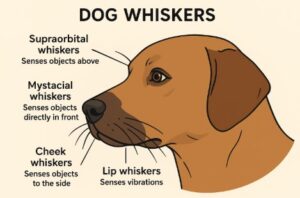
Here’s why dogs have them:
- Sensory perception:
The whiskers are linked to nerve endings, and hence are very sensitive to touch and vibrations. This enables dogs to identify objects, even when there is darkness, and when there is movement around.
- Spatial awareness:
Whiskers enable the dogs to estimate the size, shape and distance of things in their surroundings. As an example, they are able to know whether they can squeeze through an aperture without hitting something.
- Protection:
Whiskers are a type of early warning. When something rubs against their face, particularly the face of the eyes or nose, it causes a reflexive in order to avoid possible harm.
- Communication/ mood sensing:
Whiskers also positioning in dogs is a sign of emotions. When the whiskers face forward, it might be taken to signify curiosity or alertness and when they are turned back, it may signify fear or submission.
- Hunting and detecting prey (ancestral trait):
Whiskers were crucial to the wild ancestors to sense the movement of prey and move in the thick shrubs.
Fun fact: You must never cut the whiskers of a dog, it will lose its way and feel unsafe about its surrounding.

why the whiskers are so much better than the ordinary hair:
- Deeply imbedded in follicles:
The dog has a follicle that is deep in the skin that produces each whisker unlike ordinary hair. A lot of nerves and blood vessels envelop this follicle, and that is the reason why whiskers are very sensitive to the tiniest touch or movement of air.
- Related to the nervous system:
Each of the whiskers is an antenna. The bottom nerves relay messages to the brain each time the whisker comes in contact with an object or when air pressure changes. This enables the dog to sense the surrounding without touching it.
- Harder and coarser than the usual hair:
The whiskers tend to be harder, longer and stronger than the fur that encircles them. This rigidity will aid them in detecting much finer vibrations or motions in the air that otherwise would escape notice by common fur.
- Independent movement:
Minuscule muscles at the base of the tail allow dogs to move their whiskers a bit. This enables them to thrust the whiskers ahead when they are interested in something or pull them back a little when relaxed to facilitate information gathering.
- Specialization, rather than ornament:
Fur keeps you warm, and insulated, but the whiskers are only sense. Hacking or injuring them may disorient the dog since it also gets deprived of its radar system.
Therefore in essence the whiskers are some sort of tiny biological radioscope that enable the dogs to see something with their face!
Whiskers on dogs are not simply on any part of the animal, but they are in strategic spots that help the dog to collect various forms of information:
- The supraorbital whiskers:
- These are eyelash like, but much more sophisticated.
- They assist in the shielding of the eyes by causing a blink reflex in case something gets too close.
- They also assist dogs to estimate objects above them or feeling movement of the face.
- On the muzzle (mystacial whiskers):
- These are the largest whiskers, and those that you notice most of the time.
- They assist in the detection of objects just in front of the dog and the detection of minute currents on the air that are brought about by moving objects or prey.
- they enable the dogs to touch things without touching them with their nose.
- On the jawline/cheeks:
- Whiskers are used in this area to ensure that dogs move in narrow places or measure distances.
- They give additional perception to the objects close to the side of the head.
- On top of the lips (also known as carpal or upper lip whiskers):
- They sense vibrations and other slight food-related movements and help the dogs find out how to seize or chew something affordably.
Did you know fact: certain whiskers are even able to sense changes in the direction of the wind! That is the reason why a dog may freeze or shake its head when it feels that something is approaching it but far apart- it is feeling it with its whiskers.
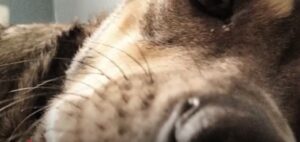
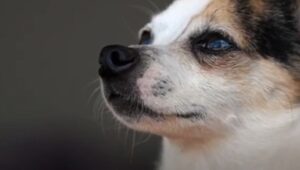
The size, quantity, and saliency of a dog’s whiskers may differ very widely, according to the breed, and the explanation of it is very practical:
- Breed history and purpose:
- The hunting or work breeds (such as retrievers, terriers, or hounds) tend to possess longer and more delicate whiskers. These whiskers assisted their ancestors in the detection of prey, undergrowth or objects under low-light situations.
- Short or few whiskers on companion breeds (such as toy breeds or lap dogs) are due to the fact that they did not need to hunt or navigate rough environments.
- The shape of the face and the position of the whiskers:
- Long-muzzled dogs (e.g., German Shepherds, Collies) have longer whiskers which enable them to detect objects further in front of them.
- Dogs with flat faces (e.g. Pugs, Bulldogs) are cut shorter in whiskers since they are already nearer to things (their noses), and need not depend on whiskers so much to recognize their space.
- Sensory needs:
- Dogs that traditionally had to operate in darkness or in tight spaces (such as terriers going down a burrow) developed an exceedingly sensitive whisker, sensitive to airflow and vibration.
- Whiskers enable such dogs to map the world around them, without looking at it.
- Individual variation:
- Even inside a breed, there are a few dogs with more, longer, or thicker whiskers–as there are humans with more or less eyebrows or eyelashes. It can be affected by genetics, age and health.
Quick tip: There are actually dogs who lose whiskers in old age or when they incur some minor injuries, although they tend to grow back. Clipping or removing them can also render dogs disoriented particularly when they are used to them as a means of detecting the environment around them.
how whiskers are a kind of biological radar:
- Detection of air movement:
- Whiskers are very sensitive to minute air current changes.
- The faintest current of air produced by any moving body near at hand will bend the whisker.
- At the base of the whisker the nerves sense this bending and transmit messages to the brain and cause the dog to know something is coming even before they see it.
- Vibration sensing:
- Whiskers are able to sense vibrations around. As an illustration, as a different animal passes by, it generates little air turbulences.
- Dogs are able to sense these tiny vibrations to identify prey, other animals or even in coming humans.
- Spatial mapping:
- Whiskers are able to measure length and size of objects around.
- The moment the whisker contacts something the brain of the dog determines how far it is and whether it is able to squeeze into a small hole.
- This is the reason dogs are able to move at night without hitting the furniture they are just touching the room with their whiskers.
- Muscle control for focus:
- The muscles at the end of each of the whiskers are tiny and enable the dogs to either push them forward or backward.
- When they are inquisitive or on the lookout, they stick their whiskers out to scan things.
- Whiskers are drawn back when in a relaxed or sleeping situation to decrease sensitivity.
- Association with other sense:
- Whisker messages are all integrated with the brain with sight, hearing, and smell.
- This gives a more holistic representation of the environment particularly in low light areas or when the environment is cluttered.
Simply put, whiskers enable the sense of the things that cannot be perceived by the eyes or ears of a dog, as they have radar on their faces!
Both dogs and cats use whiskers, although with a slight difference because each has different behavior, mode of hunting, and anatomy:
- Sensitivity:
- The whiskers of both dogs and cats are very sensitive, but those of cats are more sophisticated and usually sensitive to small movements of the air.
- Cats use the whiskers as an important tool in hunting and maneuvering in narrow areas, particularly during nighttime, but dogs use them as a means of general awareness and object detection.
- Movement:
- Cats have the ability to move their whiskers around actively forward and backward to gauge distances or smell prey.
- Dogs are also able to move theirs as well, though not on the same scale; their whiskers tend to move less, and only to warn them of something or something moving in the air.
- Placement:
- Whiskers around the muzzle, above the eyes and at the back of the forelegs are very prominent in cats.
- Dogs possess the greatest part of their muzzle, above their eyes, and occasionally on the cheeks, in the form of whiskers. This position indicates their varying requirements, cats are stealth hunters whereas dogs, use their sight, smell, and air senses a lot.
- Purpose:
- In cats: whiskers are essential in hunting and climbing and finding specific space.
- In dogs: whiskers are useful to sense geographical and spatial awareness, judge obstacles in the vicinity, sense movement, and even express minor emotions.
- Behavioral differences:
- When frightened cats will flatten their whiskers, or when curious, will push them forward.
- The same is true of dogs, except that their overall whiskers are not so expressive. Rather, the dogs apply tail and ear placement as a means of communication.
Short summary: The whiskers of dogs resemble a general purpose radar, whereas those of cats are more that of tools of hunting and camouflage.
Also read- Proven pet hair harmful and why ? 4u

