
Revolutionary meta Ray-Ban Display glasses by meta will introduce AI display and neural band, yet create privacy issues because Apple and Google are also developing similar AR wearables.
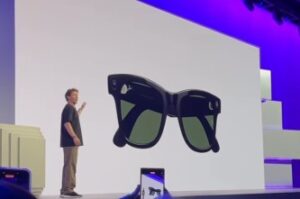
What is it
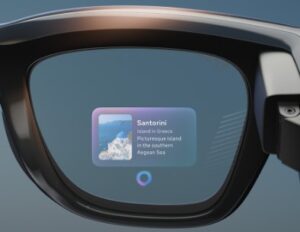
- The product is named: Meta Ray-Ban Display, which are a pair of smart glasses that have an in-built full-color display in the right lens.
- They comprise camera(s), microphones, speakers and utilise a wristband controller known as the Meta Neural Band. This employs EMG (electromyography) to pick up the smallest movements on the muscles to be able to operate the glasses (e.g. gestures) without actually touching them.
- The show should be unobtrusive: not seen by the user, but seen on the outside; it should be used to provide short-term communication (messages, navigation, live translate, etc.), not immersive AR.
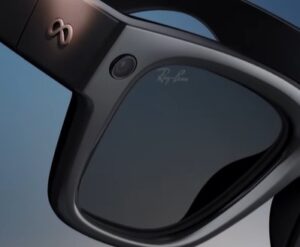
Launch & Price
- Price: US $ 799, comprising of both glasses and Neural Band.
- Availability: beginning from September 30, 2025 In U.S.
- Expansion: It is to launch the product in the United Kingdom, France, Italy, and Canada in early 2026.
Specs & Features
- Battery life: approximately 6 hours of mixed; and up to approximately 30 hours with collapsible charging case.
- The Neural Band: waterproof, lightweight, available in several sizes: the Band itself can last up to 18 hours on battery.
- Other features:
- Real Time translation and live captions.
- Fashion Walking / pedestrian movement.
- Control of the media, messaging, video calls (through WhatsApp, Messenger, Instagram) and previewing/sharing photos.
Demo Performance / Reception
- The initial glitches during the launch (connection glitches / WiFi) are something that has been identified, but which Zuckerberg explained with the network of the venue.
- Some analysts are skeptical about the number of consumers that will purchase this the first time, as they argue that the software and use-cases will have to evolve.

Strategy of Broader Context and Meta.
- These glasses are one of the steps of Meta entering wearable AI gadgets, they are setting it as a precursor to more sophisticated AR glasses (such as the Orion prototype) in the future.
- The glasses are being labeled by Meta as having a product category of Display AI glasses.
Key Privacy Concerns Raised
These are the primary concerns that individuals are raising, particularly regarding the glasses produced by Meta / Ray-Ban, which will be generalized in the smart AR glasses market.
- Recording / Camera concealed or not conspicuous.
o The shape of glasses implies the miniature size of cameras, which are at times discrete. The bystanders might not know when they are being photographed or recorded. The LED displays can either be subtle or blocked.
o Voice-triggered/AI-triggered recording/photo capture is used in numerous features, and some auto-image capture (or image streams) can be used in features such as style-suggestion / scene understanding etc., which users might not be aware.
- Storage, retention and use of data (in particular AI training).
- The policy of Meta enables one to save voice recordings (including misactivations) within a span of one year. It is worrying how and when they are utilized so as to train AI models. There is no default opt-out sometimes used by the users.
- Photos / images can be uploaded to cloud, analyzed, maybe stored, utilized in product improvement. Advocates signal the ambiguity regarding whether Meta is sure using the images of the Ray-Ban glasses to train its models.
- Face recognition / identity / profiling.
o Such tools as the I-XRAY example (Harvard students) revealed that it is possible to stream Ray-Ban glasses and apply some external AI to recognize bystanders (names, addresses, contacts) by using the data stored in the databases of people. Although these tools may not be inbuilt or be common, the demonstration shows that they can be abused.
o Profiling/Personal information exposure in the streets, unwillingly (e.g. a person passing by) as these devices get more common and capture more of the environment around.
- Bystander privacy / consent
o When an individual (wearer) uses glasses with camera/mics they are not aware of it. The glasses have to appear like normal suns glasses to break the traditional norms (seeking permission, presence of a camera).
o Laws (in various nations) also are different; at some locations, individuals might be given inadequate protection.
- Sensor / biometric data leakage.
o Carrying devices such as Apple Vision Pro, there is a concern regarding eye-tracking: how much data is gathered on where you look, how long, etc., whether it is available to apps/devs, whether they are able to leak sensitive data (moods, health etc.). A demo by a researcher was recorded by the name of GAZEploit indicating eye-tracking through avatars could reveal typed passwords / PINs without protection.
o Surroundings data: cameras, LiDAR etc. can capture much of what is around you (personal areas, houses, inhabitants) and even though device might store it locally, there are questions of how safely, how accessible to applications, whether that can leave it, etc.
- False alarms / accidental registering.
o AI voice features (such as voice triggers or voice prompts), voice features that engage pictures automatically (such as look), or features that enable pictures to be captured could result in unintended captures. Some of them can be stocked either in the short-term or in the long-term. It may not be evident or known to the users.
- Openness and end user control.
o What is the level of control by the user? Is it possible to choose features (e.g. opt-in)? Is it simple to delete the stored information (photos, audio)? Do users understand what data is being used and what (product improvement, training AI, etc.) with it?
- Legal / regulatory exposure
o Certain jurisdictions (e.g. EU) have stricter regulations (GDPR etc.) regarding consent, data gathering, biometric data, usage of personal images, voice data etc. Products that gather and process the personal data (particularly sensitive/more personal biometric/voice/image data) can be subjected to regulatory review or compliance enforcement.
Conclusion
The Display glasses by Ray-Ban produced by Meta represent a significant move towards mainstream wearable AI with a combination of a fashionable look and functionalities via in-lens subtleties and controls on a neural band.
As Meta keeps making strides ahead of its competitors, such as Apple and Google, in the development of their daily wear smart glasses, the market environment is still dynamic: Apple is focusing on privacy and local data processing in its Vision Pro system, and Google is tentatively returning to the market following its earlier blunders. Nonetheless, the issue of privacy, be it covert surveillance or the storage of data or even the abuse of facial recognition, is an essential obstacle to the trust of the citizens.
Innovation will not be the only thing that will determine the future of smart glasses, but also transparency, regulation, and how the companies will convince the users and bystanders that their data and identities are not compromised.
Also read- Google AI glass


2 thoughts on “unveils $799 Revolutionary Meta Ray-Ban Display glasses by Mark Zuckerberg”