
Tour New Orleans, Louisiana, the city of jazz, Mardi Gras, Creole food and history. An exciting cultural, strong, and memorable city.
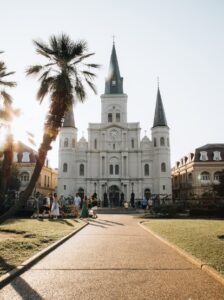
New Orleans, Louisiana
Location
- Southern Louisiana, the United States.
- On the Mississippi River, near the mouth of the river at the Gulf of Mexico, some 100 miles (160 km).
- The location is considered to be low-lying in most places, with numerous levees in place.
Geography & Climate
- Nickname: The Crescent City (due to the fact that the Mississippi River is curving around it), The Big Easy.
- Area: ~349 square miles (approx. 906 km²).
- Climate: Humid subtropical.
o Summers Hot, humid with frequent thunderstorms.
o Mild winters.
o Hurricane-prone (most infamously Hurricane Katrina in 2005).
- Distinctive Characteristic: Swampland-based, therefore the soft soil results in the construction of buildings and tombs above ground.
History
- Founded: in 1718 by a French explorer called Jean-Baptiste Le Moyne de Bienville.
- Colonial Past:
o French (1718–1763)
o Spanish (1763–1800)
o French (briefly, 1800–1803)
o Bought by U.S. in Louisiana Purchase (1803).
- Cultural History: French, Spanish, African, Caribbean, and Native American.
- Civil War Age: Taken by Union soldiers at an early age in 1862, which provoked few acts of destruction of the same.
- 20 th Century: Jazz, Creole food and Mardi Gras.
- 2005: Hurricane Katrina wrecked the city, overflowing levees and submerging approximating 80 percent of the state of New Orleans. The city has been on the road to recovery but still is strong.
Demographics
- Population (2025 est.): the city has a population of about 377,000, and metro area (population) of about 1.2 million.
- Diversity:Good African American, French Creole, Cajun, Caribbean and Vietnamese.
- Languages: English, traces of French and Spanish language still used; French Louisiana Creole is also spoken.
- Religion: It is mostly Roman Catholic (which is not very common in the traditionally Protestant U.S. South).
Culture
Music
- Jazz City – Louis Armstrong, Jelly Roll Morton and Wynton Marsalis.
Other genres : blues, funk, zydeco, bounce (hip-hop).
Festivals
- Mardi Gras (Fat Tuesday): Parades, beads, masks, floats – world-famous celebration based on the tradition of Catholicism.
- Jazz & Heritage Festival: Jazz, gospel, blues, and so on.
Food
House special Creole and Cajun food:
- Gumbo – stew with roux base.
- Jambalaya- rice with meat, seafood or sausage.
- Po’boy – French bread sandwich.
- Beignets- Fried disk with powdered sugar (Café du Monde is legendary).
- Crawfish boils –social meetings with experienced shellfish.
Arts
- Wealthy history of street performance, visual arts and literature (Tennessee Williams, Anne Rice).
Significant Sights and Destinations.
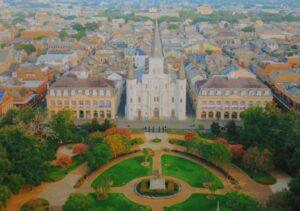
- French Quarter: Oldest part of the city with Bourbon street, colonialism and nightlife.
- Jackson Square and st. Louis cathedral: Familiar city symbols.
- Garden district: Streets with oaks, mansions.
- Preservation hall: Longest running jazz hall.
- Audubon Zoo and Americas Aquarium.
- National WWII Museum: Best rated America museum.
- Omnibuses: The St. Charles Avenue omnibus.
- Cemeteries – (“Cities of the Dead”): Tombs that are built above ground.
Economy
- Key Sectors:
o Tourism (millions of visits per year).
o Shipping (high port on the Mississippi).
o Oil & gas, petrochemicals.
o University education and medical care.
- Problems: Flood risks, poverty and infrastructural problems.
Sports
- NFL: New Orleans Saints (Superdome is home stadium).
- NBA: New Orleans Pelicans.
- Has devoted fan base – in particular Who Dat Nation (Saints supporters).
Transportation
- Airport: Louis Armstrong New Orleans International Airport (MSY).
- Streetcars: Ancient and still extant.
- Port of New Orleans: This is one of the biggest in the United States.
Resilience & Modern Life
The city of New Orleans is said to have a soul-a place where people live outside, always partying, and cultural mix is the order of the day. The city has been able to rebuild its own identity and flourish despite disasters such as the Katrina and Ida, which is unlike any other city in the United States.

3–5 Day Tourist Itinerary
Day 1 -Basics of the French Quarter.
- Morning:
o Caffe du Monde → beignets and coffee.
o St. Louis Cathedral → visit Jackson Square.
- Afternoon:
o Stroll Bourbon Street→ music and shops.
o Lunch: have a Po-boy at Johnny Po-Boys.
- Evening:
o Dinner either at Antoine or Galatoire (classic Creole).
o Preservation hall Jazz performance.
Day 2 – Garden District & Uptown
- Morning:
o Ride in the street cars on St. Charles Avenue.
o Mansions in Tour Garden District.
- Afternoon:
o Lafayette Cemetery No. 1 (raised tombs).
o magazine street 2 boutiques and cafes.
- Evening:
o Dinner at Commander Palace (symbolic).
o Take a walk down oak-lined streets.
Day 3 – Museums & Riverfront
- Morning:
o National WWII Museum (global).
- Afternoon:
o Steamboat Natchez across the Mississippi.
o Lunch: Gumbo or Jambalaya at Coop place.
- Evening:
o Frenchmen Street → live jazz, more local than Bourbon Street.
Day 4 – Nature & Neighborhoods
- Morning:
o Swamp tour (alligators, Cajun guides).
- Afternoon:
o City park (sculpture garden, New Orleans Museum of art).
- Evening:
o Crawfish boil or dinner at a local store.
Day 5 – Bonus Experiences
- Mardi Gras World →How floats are made.
- The Treme area is a neighborhood of African American culture and jazz.
- Local food tour → pralines, muffulettas, red beans and rice.
Top Restaurants & Food Spots
- Café du Monde – Beignets.
- Commander Palace- Fine dining Creole.
- Dooky Chase’s –Historical soul food (civil rights history).
- Central Grocery – Original muffuletta sandwich.
- Willie Mae Scotch House- Famous fried chicken.

Conclusion
New Orleans, Louisiana is not merely a city but a living cultural tapestry which is an amalgamation of French, Spanish, African and Caribbean. Whether it is the vibrant stores of the French Quarter or the melodies of the grandeur of jazz that fill the air upon Frenchmen Street, every time spent here is a celebration of life. It is unlike any other destination within the United States due to its food, festivals, and history. New Orleans remains undefeated even after the hurricanes and floods as the city of strength, innovativeness and unshaken spirit. New Orleans can offer a journey you will remember forever whether it is music, history, cuisine, or any other experiences that people might have.
Also read- Great Smoky Mountains, Tennessee/North Carolina since 1934


1 thought on “Stunning New Orleans, Louisiana since 1718”