
Trump Introducing a $100K annual fee on H-1B visas , which has raised controversy about the U.S. job movement, the effect on the tech industry, and migration of talent to other regions and brought forth challenges in legal litigation.
What has been announced
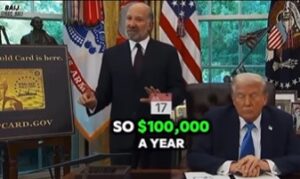
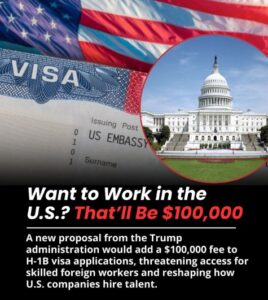
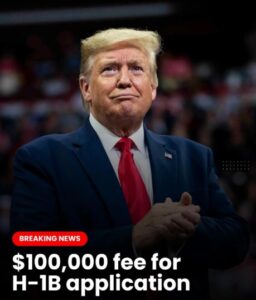
- On September 19, 2025, the President Donald Trump issued an announcement that will entail a new fee of H-1B visa applications of $100,000 dollars per year.
- The fee is charged on a per-application basis (hence an H-1B petitioner that is an employer would pay it most probably).
- The given goal is to deter the perceived abuse of the H-1B system by the administration: employing foreign workers at a lower rate, not taking advantage of the talent of U.S. workers, and importing workers to occupy comparatively low-skilled or low-paying positions.
- Large tech corporations and employers are also likely to be hit significantly; the proclamation appears to be specifically targeted at big companies that regularly employ H-1B workers.
What remains ambiguous / has gone wrong.
- Legality / Authority: There is a question of whether a presidential proclamation can alone raise such a sizeable new visa fee without Congressional action. Certain commentators anticipate legal problems.
- Implementation details:
o The fee scale and nothing but exemptions (nonprofits, universities, small businesses, etc.).
o Should the fee be applied to new H-1Bs or renewals as well.
o At what point will it become effective.
- Impact: The fee is very high as opposed to the existing H-1B filing fees. To put it into perspective: the present USCIS charges of regular H-1B filings are significantly less (hundreds and low thousands) including registration charges, petition charges, and other requirements of the employer. Such $100K fee would tremendously increase the cost.
- Economic / Workforce effects:
o May cut back on the number of H-1B petitions being made, particularly in the positions with lower wage rates.
o Could encourage companies to outsource further or to recruit locally despite it being more expensive.
o That may impact those industries that are very dependent on H-1Bs – tech, research, academia, etc.
o Could put foreign talent off.
- Policy objectives vs. trade-offs: The administration makes it sound like the U.S. workers should be safeguarded and discourage abuse. Critics however caution of lack of competitiveness especially in areas where specialized foreign talent is lacking. Others are concerned with innovation, research ability, etc.
What this DOESN’T do / what to watch
- Meanwhile, it does not change other aspects of the H-1B program (lottery system, prevailing wage rules) though there have been reports of other possible changes.
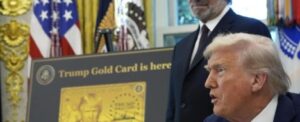
- The new visa-options of the new Gold Card and the Platinum Card are also being introduced. Those seem to be distinct yet connected endeavors in the general immigration reform.
The response of various groups.
Tech Industry & Employers
- Major technology companies (Google, Microsoft, Amazon, Meta, etc.) are supposed to suffer the most. They submit thousands of H-1B every year.
- This will, according to industry groups, argue:
o Adds unreasonable costs (a petition that once cost a user in the range of $6K might cost them over $106K now).
o Make U.S less competitive, because talent can come to Canada, Europe or the emerging tech hub of India.
o Promote off shoring, which could become less expensive to relocate jobs offshore.
Universities & Research
- Universities and hospitals as well depend on the H-1Bs in terms of professors, scientists, and doctors.
- Numerous argue that the price may leave research employment crippled, or cause institutions to need to forego foreign recruitment.
Immigrant Advocates
- Groups refer to it as a wealth test of immigration because only the largest corporations were in a position to sponsor an immigrant.
- Radicals Are also threatening to close down small businesses and start-ups- where most of the innovation is made.
Supporters of the Policy
- Trump supporters describe it as a pro-American employee action:
o It is alleged that companies are using H-1Bs to get cheaper foreign workers.
o The argument over the fee will compel companies to think twice and focus on domestic talent.
- Some of the U.S. worker associations embraced it on the basis that it will limit the exploitation in the outsourcing sector.
Expected Impacts
- Severe decline in H-1B submissions – and in particular by smaller firms and universities.
- Change in recruitment trends – big tech can offshoring work rather than compensating.
- Legal issues — they believe that legal suits will arise to query whether a president can impose such a fee at will.
- Immigration pipeline unloading – foreign students in the U.S. could have fewer sponsorship opportunities, and it is likely that they may depart after their degrees.
- Talent movement- out to the countries (such as Canada) may receive the best talents who currently would not come to the U.S.
Timeline-
Trump’s First Term (2017–2021)
2017
- Buy American, Hire American Executive Order Signed.
o Installed instructions to suggest reforms to make sure that H-1Bs are taken to the most skilled or the highest paid.
o Strong beginning of tougher adjudications.
2018–2019
- Denial rates of H-1Bs are increasing (approximately 7 percent in 2015 to approximately 24 percent in 2018).
- Request of Evidence (RFEs) increased, processing became stagnant, and it became expensive to employers.
- Department of Labor further enforced prevailing wage examination, which necessitates an increase in wages of certain positions.
2020
- H-1B ban during COVID-19: Trump put a pause on new H-1B visas based on the need to protect U.S. workers in the wake of pandemic unemployment.
- Tried to change the rules (thrown out in court) to:
o Limit definition of specialty occupation.
o Increase minimum salaries among foreigners.
2021-2024 (Biden Administration) post Trump
- Biden overturned numerous of the denials and bans.
- Denial rates reduced sharply (to approximately 4 percent).
- H-1B electronic lottery system (also introduced in 2020) was retained, but was also criticized as being gamed by staffing firms.
- Talks of reforms were made, although no significant reforms.
Trump’s Second Term (2025– )
September 19, 2025
- Order that was signed and imposed a fee of $100,000 a year on each application of H-1B.
o Put in perspective as abusiveness discouragement, compelling employers to hire U.S. workers.
o Critics refer to it as a wealth test, and expect masses to drop filings.
o Details of implementation (renewals, exemptions, time frame) are yet to be clear; legal issues are likely.
Alongside $100K fee:
- The new visas are Trump Gold Card and Trump Platinum Card, where the company plans to attract the best world talent with higher skill/income levels.
- Indicates a change to an elite-only immigration and limited traditional work visas.
Overall trend:
- First Term → bans, increased refusals, provisional bans.
- Biden Years → relaxing, back to regular approvals.
- Second Term (2025) → theatrical upgrading: $100K, and the change to super-visas.
Conclusion
The most recent action taken by Donald Trump in creating a charge of $100,000 a year to apply H-1B visas is one of the most hostile changes in U.S. immigration policy.
Although it is presented as a remedy to safeguard American employees and reduce perceived offenses to the program, the fee is likely to produce far-reaching effects: encouraging small enterprises and colleges to stop sponsoring foreign talent, increasing the expenses of technology giants, and potentially causing qualified workers to relocate to other nations.
This is likely to be challenged in courts, and the effects in the long run might transform the U.S. labor market, line of innovations, and the competitiveness in the world market. This policy is part of a larger Trump initiative of limiting the conventional work visas and predisposing to high-competency, upper-end visas, forming a fresh immigration and work environment in America.
Also read- French First Lady Brigitte Macron 72 Present Evidence in Court That Proves She’s a Woman


2 thoughts on “Trump Introducing a $100K annual fee on H-1B visas”