
Learn about bastard sword uses, history and design. Understand what it means in the present-day in this complete guide to hand-and-a-half swords.
Introduction
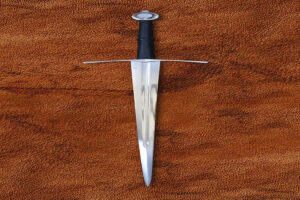
The bastard sword or, to give it a more popular name, the hand-and-a-half sword is one of the most recognizable weapons of medieval Europe. Its distinctive design, easy handling, and its versatile application established it as a favorite among knights, foot soldiers and duelists between the 13 th to the 17 th centuries. Be it a history lover, HEMA fighter, collector, gamer or author.
What Is a Bastard Sword?
Bastard sword is a European weapon that is a hand and a half sword, i.e. it can be held in one hand or one hand and two hands. It is a transition between an arming sword that is single-handed and a complete, full longsword.
The meaning of its bastard is not illegitimacy, but that it is a hybrid of the two kinds of swords.
Key Characteristics
- Blade length: 33 to 42 inches
- Length of handle: 6 to 8 inches (can fit one or two hands)
- Weight: 1.1 to 1.8 kg
- Usage: cutting, thrusting, half-swording, armored combat.
- Period: end of the medieval times to early renaissance.
The design provided the fighters with greater power, range and control; therefore it was a versatile weapon to be used on the battlefield and in duels.
History of the Bastard Sword
Medieval Origins
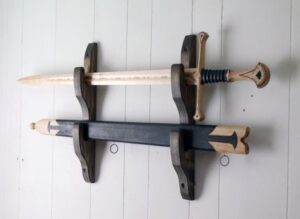
The bastard sword had been developed in the late 13 th century when the armor technology had reached a high level. Knights had to have a long powerful weapon that could be used to fight plate armor but at the same time that could be used in close fights.
Growing Popularity
In the 14 th and 15 th centuries, the usage of the sword became popular in Europe:
- England and France: on battlefield.
- German and Italian schools: fencing and duels.
- Knightly orders: as a sign of power.
- Civilian defense: it is flexible and therefore.
It was highly regarded by the way it features in art works, manuscripts and in royal tombs.
Renaissance Era
Although the impact of the firearms became dominant, the bastard sword did not stop its development. It turned into a ritual sword and fencing trainer to fencing masters, such as Johannes Liechtenauer.
The Basilica of a Bastard Sword.
The charm of the bastard sword is that it should have balance between power and precision.
- Blade
Most bastard swords feature:
- Tapered edges
- Strong central ridge
- Sharp tip for thrusting
- Broad base for powerful cuts
The sword was able to cut through chain armor and use any holes in plate armor.
- Hilt and Grip
The longer grip allows:
- Played with shields One-handed hits.
- Maximum forcible swings with both hands.
- Both transitions between techniques are smooth.
Leather wrapping or cord wrapping was comfortable and controlling.
- Crossguard
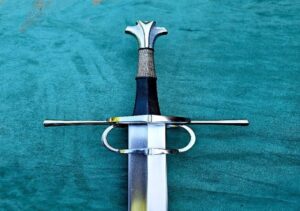
The hand of the user was shielded by a broad crossguard when there was clashing. In order to improve and add decorations, some are curved quillons or intricate guards.
- Pommel
The blade may have been balanced, but other than that, the pommel could serve as a club in a tight space.
The use of the Bastard Sword in War.
The bastard sword was also acclaimed due to its ability to be used in a tactical manner. The main methods of fighting are as follows:
- One-Handed Combat
Worn in combination with a shield, or in the battle on horseback. It promised manoeuvrability and nimbleness.
- Two-Handed Power Strikes
Sanctioned strong down performs that could harm an armor or even crack a shield.
- Half-Swording
To improve thrusting accuracy, a knight was able to hold the blade by the middle. This worked particularly well with armored opponents.
- Grappling & Close Combat
In ancient martial arts, pommel, disarms and throws were also used to terminate fights in the shortest time possible.
This flexibility rendered the bastard sword a dreadful sword of battle.
Bastard sword vs. Longsword: Difference?
The difference between the two terms is obvious, even though many people use their terms interchangeably:
Bastard Sword
- Shorter grip
- Slightly lighter
- One hand and two hand usability.
- More flexible and multifunctional.
Longsword
- Longer grip
- In most cases, needs two hands.
- Streamlined in fencing skills.
- Enhances better leverage and coverage.
In simple terms:
The hybrid is the bastard sword, which is a sword more flexible than a longsword, with greater power than a single-handed sword.
The modern bastard sword uses.
The bastard sword is today a useful tool in other fields.
- Historical European Martial Arts (HEMA).
Medieval manuals are studied by the practitioners in order to recreate combat methods.
- Reenactments
Replicas are used in historical groups to battle, participate in tournaments and demonstrations.
- Collectibles
Good counterfeits are valued by the hobbyists and amateurs.
- Movies, TV & Games
Bastard swords are popular in culture, and these are represented by The Witcher and Game of Thrones.
- Fitness & Training
Training on swords provides strength, agility as well as co-ordination.
Why Does the Bastard Sword Have So Many Followers?
- Iconic medieval design
- Balanced performance
- Rich cultural significance
- Training safe and practicable.
- Highly collectible
It is one of the most available and most coveted swords in history due to the nature of it being hybrid.
FAQs
- And what a name hast thou, the bastard sword?
The bastard is called so because it is a hybrid weapon; it is a cross between a one-hand sword and a two-hand longsword.
- How long is a bastard sword?
Normally 33 to 42 inches in length with a grip of 6 to 8 inches.
- One hand can it be with a bastard sword?
Yes. This is particularly adapted to operate using one or two hands, and hence it is highly versatile.
- Is it the bastard-sword that is like a longsword?
No. A bastard sword looks like a shorter sword but is more adaptable in between one hand and the other.
- Better with beginners to HEMA than Waverly swords?
Absolutely. People who have never used a sword pick the bastard sword due to its equal weight and comfortable grip.
- What was the old sword of the bastard?
It was applied in battlefield fighting, dueling, fighting with armors, and knightly war between the 13 th and 17 th century.
Conclusion
The bastard sword is one of the most influential weapons of the medieval Europe, which combined the power, flexibility and beauty. Its design enabled the knights to be useful both in armor and unarmed combat and its legacy still lives in martial arts, entertainment and historical studies. The bastard sword is the eternal weapon that symbolically copes the divide between utility and art both as a battlefield weapon and as a heritage.
Also read- Best 3- fencing swords types


1 thought on “Best 5- bastard sword uses”