
The 6 month sleep regression? Find out the reasons behind the sudden changes in the sleep of your baby and what to do to ensure it lasts longer.
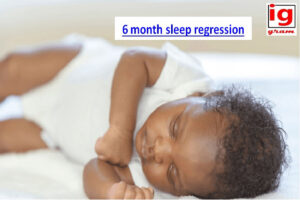
6 Month Sleep Regression: Why Your Baby Lately Refuses to Sleep- and What Works.
Only as you had gotten used to sleep getting into a rhythm, all crumbles up once again.
Your six months old is getting more frequent waking up, napping and crying as soon as his or her head touches the mattress. Sound familiar? Nothing wrong in what you are doing. It is probably the 6 month sleep regression: a very frustrating phase in the development of your baby, but a very real one.
The good news? It’s temporary. And by a proper attitude, you can make it through with your reason (mostly) intact.
Definition of several months sleep regression?
Six months sleep regression is a phase as a baby who was sleepy before will wake up every minute, sleep deprived, or will not be able to sleep or take a nap.
In other words, this regression is closely linked with significant developmental leaps, in contrast to previous regressions. Babies are developing speedily at six months, physically, mentally, and emotionally, and sleep usually suffers the blow.

The reason behind the 6 Month Sleep Regression.
The sleep regressions do not come out of the blue. There are a number of giant changes simultaneously at six months.
- The Development of the Brain Is in Overdrive.
Your baby is learning to:
- Sit independently
- Roll both ways
- Recognize familiar faces
- Understand cause and effect
That developing brain does not wind up very easily at night. Most of babies rehearse new abilities their crib rather than sleep.
- Sleep Cycles Gain Adult Character.
At this age, infants pass through less sleep. Unless they know how to self-soothe, they can completely wake up between cycles.
- Separation Anxiety Begins
You find that your baby now understands that you are an individual person- and this may not be a very pleasant understanding. Waking up at night would tend to go up since they would want to know that you are there.
- Teething Discomfort
Some babies do not teethe by the age of six months, but a good number of them do. Sore gums can cause:
- Short naps
- Frequent night wakings
- Setting back to sleep: trouble.
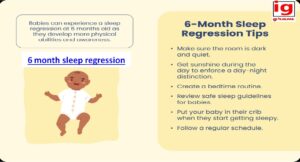
Generalized Indications of 6 Month Sleep Regression.
All babies do not present with the same symptoms but the most prevalent symptoms reported by the parents are as follows:
- Waking every 1–2 hours at night
- Short or skipped naps
- Crying when put down awake
- The requirement to take additional assistance to sleep.
- Excessive daytime infantileness.
This regression is a high possibility in case your baby was sleeping relatively well and then suddenly, it is not.
Duration of the 6 Month Sleep Regression?
This is the question that all sleep-deprived parents ask.
The 6 months sleep regression is normally 2-6 weeks. In the case of some babies it is hardly noticeable. To others it is endless–but it will wear away.
The duration is very often dictated by the methods of managing sleep habits at this stage.
What Reality Reveals to Be of Use in the 6 Month Sleep Regression.
It is not a magic solution, but there are ways that a difference can be made.
Maintain a routine Sleeping Schedule.
Babies are creatures of habit and this is particularly when they are in transition.
Aim for:
- 2–3 naps per day
- Wake windows of about 2–3 hours
- Regular bedtime (typically 6:30 -8:00 pm)
Alleviate Stressful Bedtime Boys and Girls.
sell what is quick and reliable:
- Bath or wipe-down
- Pajamas
- Feeding
- Book or song
- Bed
Conducting the same actions at night informs the brain that it is going to sleep.
Promote Sleeping (Gently) on her own.
At 6 months, it is an excellent age to train a baby how to fall asleep, provided that you have a parenting style that suits it.
You do not need to go directly to cry it out. Gentle options include:
- Baby down and sleepy: Placing infants.
- Slowly withdrawing the rocking/feeding to sleep.
- Making them verbal word of assurance and then picking them up.
Watch Wake Windows Closely
Not better, but more poorly, overtired babies sleep, still.
In case naps are not long, shift bedtime to the earlier. A bedtime that is earlier tends to result in less night waking not more.
Solve Teeth Pain (When Necessary).
In case teothing may appear to be a possibility:
- Pre bicycle bedtime off-the-frozen ice-cream lisp.
- Talk to your pediatrician regarding the correct management of pain.
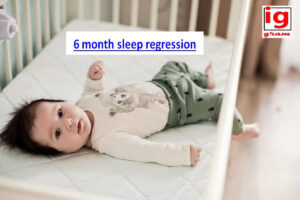
What Not to Do (Yet It feels So Tempting).
When doing the regression, one can find themselves in a survival mode. The following few habits might complicate things in the long run:
- The use of sleep crutches each night.
- Radical alteration of bedtime on a daily basis.
- Leaving baby up too late in hopes that he/she will crash.
Temporary solutions have the effect of lengthening the regression instead of being short-term.
Is This a Regression–or Some Such Thing?
Occasionally, sleep disturbances are not a regression at all.
Hopefully, there are other options:
- Growth spurts (nocturnal popularity of biscuits)
- Illness or congestion
- Schedule misalignment
- The environmental factors (travel, noise, light)
.
In case the sleeping problems do not resolve after 6-8 weeks, it can be advisable to evaluate the routines or a pediatric sleep expert.
FAQ:
- Is the 6 month sleep regression actual?
Yes. Although all babies do not experience it, many experience it. It is associated with true developmental and neurological transformations.
- Is sleep training able to prevent the 6 month sleep regression?
Sleep training will not prevent development, but with the acquisition of self-soothing skills, night wakings can be reduced.
- Is it possible to feed my baby every night when he/she wakes?
Not always. Even six months old require night feeds, but they might be habitual and not based on hunger.
- Is there a 6 month sleep regression on naps as well?
Yes. Natural drowsiness and sleep resistance in short naps are quite frequent at this stage.
- What would I do when I would think that my baby is overtired?
The symptoms consist of fussiness, eye rubbing, back arching, and fighting sleep even when one is obviously exhausted.
- Should co-sleeping be used as a remedy to sleep regression?
It might be of temporary assistance to certain families, however, it can lead to establishing new sleep associations. Select the best one that suits you.
Final Thoughts:
The 6 months sleep regression may appear to be like a wicked joke considering weeks of good sleep. Nevertheless, it is not a failure but an indication that your baby is learning, growing, and getting to know this world better.
Stay consistent. Keep routines simple. PC, react calmly, but not in a panic.
You will have better sleep–it will come sooner than you are thinking.
Also read- Top 5 mistakes after knee replacement

