

Capable Supreme court by 6-3 majority allows to resume ICE patrols into Los Angeles, permitting Trump to take active immigration patrols. The Justice Kavanaugh and Justice Sotomayor decision of 6-3, has nationwide implications about racial profiling, the Fourth Amendment, and the future in immigration enforcement.
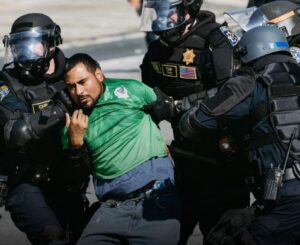

What just happened?
On September 8, 2025, the U.S. Supreme Court made a 63-minute emergency decision that struck down a lower court order prohibiting ICE – granting the agents authority to resume aggressive, roving immigration raids in Los Angeles as litigation persisted.
Key highlights:
- Restrictions of Lower Court Overturned.
The previous federal judge had already prohibited ICE to detain individuals on the basis of race, language, occupation or place without any reasonable suspicion. The emergency order of the Supreme court suspends such restrictions.
- Concurrence and Dissent
o Justice Brett Kavanaugh agreed, saying that ethnicity alone can not justify stops, but in combination with other signs it may be a relevant consideration.
o Justice Sonia Sotomayor (joined by Kagan and Jackson) dissented vigorously, notifying the decision is tantamount to legalized racial profiling against Latinos.
- Responses of Advocates and Authorities.
The decision was celebrated by DHS and the administration of Trump as a major victory where ICE can continue its business without judicial scrutiny.
The decision was denounced by ACLU, immigrant rights organizations, and officials in California, terming it catastrophic, and a sign of green light to racial discrimination. They intend to keep on leveling courtroom battles.
- Ongoing Legal Proceedings
The larger case is pending in the lower courts, where it will be heard on September 24, 2025.
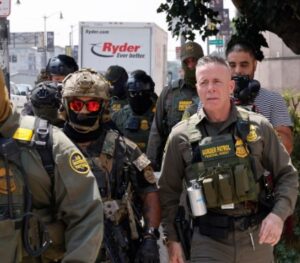

the legal battle, what the Court ordered (and didn’t), the place of precedent, and its implications to other cities can be broken down in some detail, which you may use to the extent you like.
1) The gist of legal reasoning (what was said by whom)
- Federal (Trump administration / DHS / DOJ)
Moved to quash the lower-court injunction (ordered by U.S. District Judge Maame E. Frimpong) as impeding legitimate immigration enforcement in a high-density border-adjoining locality and would be of significant impediment to operations. They petitioned the Supreme Court to stay the case as the case continues since ICE must interrogate any alien or a person suspected of being an alien. The government put the injunction in the form of excessively broad and disruptive.
- Plaintiffs / Civil-rights groups (ACLU, local plaintiffs)
Alleged that the indiscriminate nature of the roving patrols conducted by ICE in Los Angeles was targeting individuals on the basis of their race, language, employer, and neighborhood, and in sweeping up U.S. citizens, it was therefore infringing upon the Fourth Amendment and the equal-protection values. They petitioned the district court that these tactics be prevented; the district judge accepted them and imposed restrictions. Those results are the factual heart of the current lawsuit.

- Supreme Court (the emergency order / stay)
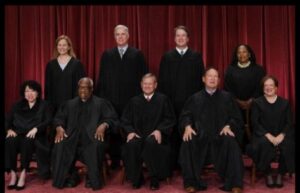
The Court (63) also kept the injunction of the district court in place in effect, which limited ICE to continue with the disputed tactics pending the trial. There is little explanation in the majority order itself, which is typical of shadow-docket stays, but Justice Kavanaugh wrote a concurrence that explained important reasoning: apparent ethnicity by itself is not sufficient to cause reasonable suspicion, but ethnicity/language/job/location can be regarded as a component of the totality of the circumstances that, when combined, might give rise to reasonable suspicion. The liberal justices (Sotomayor along with Kagan and Jackson) were highly disagreeing, that the stay is virtually giving the go-ahead to racial profiling.
2) The legal precedent and theory which count.
- Fourth Amendment- reasonable suspicion vs. probable cause. Short investigative stops have a reasonable standard (even lower than probable cause) which is called reasonable suspicion. The logical question of law here is whether a set of factors (ethnicity or language) could be included in the reasonable-suspicion calculus.
- Brignoni-Ponce (1975). This case established in 1997 by the Supreme Court as part of its rules on roving border patrol stops was that the apparent ancestry can be one of the factors but that the officers cannot use ancestry alone as the basis of the stop, the stop must be based on an established suspicion (totality of the circumstances). That sequence of cases and the totality approach are explicitly invoked in the Kavanaugh concurrence. Brignoni-Ponce to expect a leading part in briefing as well as subsequent opinions.
- Immigration statutory authority. The sources of law that the government cites to justify the officers questioning and removing noncitizens are the Immigration and Nationality Act and statutory powers, which grant law enforcement agencies the power to probe and deport noncitizens; the conflict between the statutory power and constitutional restrictions (Fourth Amendment) is the area of tension between the two. Emergency measures by the Court does not answer the question of constitutionality – it merely keeps the enforcement running pending appeal.
3) What the concurring and the dissenting views highlight.
- So on the one hand, Kavanaugh (concurrence): It has to be the totality of circumstances – such factors as local demographics, usual workplaces (day-labor, landscaping), and language may be put together so as to constitute reasonable suspicion. He emphasizes that ethnicity cannot be enough but could be an applicable variable. Such framing constricts an unambiguous prohibition of bright line but provides a greater latitude to officers on a flexible test.
- Sotomayor / Kagan / Jackson (dissent): Take the position that the stay is the de facto grant of racial profiling, that the Court has been using the shadow docket to make significant policy decisions without first briefing or argument, and that the effects (detention of citizens, chilling effects on immigrant communities, etc.) are pragmatic.

4) Reflections on other cities / state implementation.
Short run (as long as the stay is open):
- ICE may reintegrate similar roving patrols in other jurisdictions in which the government deploys them, so long as there are such local court orders. It is not a nationwide constitutional result in place — it is the interim action, but it reduces the real-world impediment to comparable aggressive action elsewhere and it indicates that this Supreme Court is prepared to permit such actions on a case-by-case body.
Medium / long term (assuming that, in the end, the government wins or losses on the merits):
- Implication If the court decision does go against the government, the chances of lower courts enjoining comparable strategies may be reduced; ICE might increase offensive, selective raids in additional megalopolises (particularly in California, Texas, Florida, etc.), and the sanctuary policy on a local scale would be stretched.
- Should the ultimate decision support plaintiffs, a new stronger boundary on race/ethnicity-based targeting would be reinstated and more specific guidance on what combination of factors is reasonable to be considered as a reasonable suspicion.
Responses by the local government that may dampen or divert enforcement:
- City/county litigation and TROs (as here).
- Local non-cooperation policies / sanctuary which restrict aid (data sharing, detainer holds) – though not the ultimate defenses, these policies too have been challenged on federal courts.
Practical consequences on societies: More arrests in communities where ICE works, more fear and less collaboration with the local police, and higher civil-rights-lawsuits.
5) The development of similar cases (history and trends)
- Brignoni-Ponce (1975) made it clear that apparent ancestry could be taken into account, but not decisive, a time-honored precedent concerning roving patrols in the border area. Said decision is now being quoted as the foundation of whether ancestry/language can be considered as a factor of suspicion.
- Arizona v. The United States (2012) and state/federal conflicts demonstrated state authority constraints in the enactment of immigration law, but the litigation at hand is federal vs. federal (federal enforcement practice vs. federal constitutional restriction), and the dynamics are different.
- Shadow-docket trend (recent years): The Supreme Court has been imposing emergency orders / stays with minimal justification on issues of high impact; dissents have condemned the practice. The latter procedural trend is as consequential as the legal doctrines due to the fact that it alters the rate at which policy changes are implemented without undergoing a full adversarial process. There will be more opinion writing and perhaps some calls to reform the shadow docket.
6) What is next to watch (concrete milestones)
- Sept. 24 (lower-court hearing) — the case will proceed in the Ninth Circuit / lower courts; the proceeding will result in record evidence and legal arguments potentially leading to a final injunction or to further appeals.
- Risk of a full Supreme Court briefing (had the case fully briefed/argued, perhaps announced a major Supreme Court opinion resolving whether race/language/job/location combinations can amount to reasonable suspicion to justify immigration stops in non-border urban areas).
- State/local litigation and ordinances — keep an eye on new suits brought by cities/states, or actions restricting local cooperation, which could create circuit splits and would revert the issue to the high court.
Conclusion-
The stay by the Supreme Court means that ICE is temporarily allowed to do the challenged LA raids as the underlying litigation plays out. The shadow-docket stay by the Court and Kavanaugh concurrence means that the justices are willing to permit ethnicity/language/job/location to be included in a totality analysis of reasonable suspicion, although Kavanaugh opines that ethnicity alone is inadequate.
The liberal justices caution that it is a welcome to racial profiling and civil-liberties evils. The decision on the final, countrywide rule is not yet determined; the further procedure of the case (appellate record, hearings) will help to decide it.
Also read- The truth about french government colapse in 2025