

A powerful earthquake of magnitude 7.8 hit the Kamchatka peninsula in Russia causing tsunami warnings in the Pacific. Later the alerts were lifted by the authorities with no significant damage and casualty reported. Earthquake experts are alerting of the aftershocks and the region being in high risk of seismic activity.
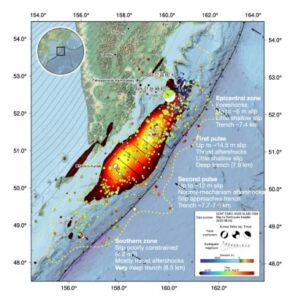

This is what has so far been known of the strong quake in the Kamchatka part of Russia:

What happened
- There was a massive earthquake with a magnitude of 7.8 according to U.S. Geological Survey (USGS) off the eastern coast of Kamchatka Peninsula, Russia.
- The depth of the quake was only shallow — approximately 1020 km below the surface.
- A series of aftershocks with the largest of magnitude 5.8 occurred.

Local Response Magnitude Discrepancy .
- The magnitude was first given at 7.2 by Russian local officials (Governor Vladimir Solodov), but in some reports it was later increased.
- There was a warned tsunami of Kamchatka and surrounding coastal waters (including Kuril Islands), although it was canceled after a while.
Impacts & Damage
- Up to this point, no reported massive destruction or deaths.
- “There were some smaller effects: the waves of 30-62 cm (1-2 ft) were registered along the Kamchatka coast, and the video footage showed the swaying of light fixtures and furniture.

Context
- Kamchatka lies within a highly seismically active area (on the Pacific ring of fire) especially along the Kuril-Kamchatka subduction zone.
- This quake is also being seen as an aftershock of a much bigger quake that occurred July 30, 2025 of magnitude 8.8.
Expert Commentary & Context
- Megacode Aftershock of Preexisting Mega-quake.
The U.S. Geological Survey is considering the magnitude 7.8 earthquake to be the major aftershock of a previous M8.8 earthquake in July.
Even aftershock could produce high-energy ground shaking, potentially cause weaker buildings to collapse, and cause other secondary hazards (such as landslides or scorer submerged) and this may occur even when the area has already been destabilised.
- Shallow depth and Faulting Style.
This quake was fairly shallow (10-20 km in depth), and it was a type of reverse or thrust faulting (the crust was compressed and pushed together). That is more likely to shake it, have more chances of surface damage, and more chances of creating a tsunami (the ocean bottom is able to be moved more quickly).
- Regional Alerts on Tsunami Warnings.
o Some warnings were given to nearby Russian coastland, Alaska (western Aleluins), and even Hawaii to portions within approximately 1000km of the epicenter.
o Nevertheless, significant threat of tsunami was found to be low to the coasts that are farther (e.g. U.S West Coast, California); warnings to the latter were not issued at all or soon canceled.
- Aftershocks Expectation
Once a quake of this magnitude has taken place, particularly after a past very big quake in the same area the aftershocks take place as per the experts. Others might be substantial in magnitude. These may extend the risk of damages.
Expected Effects & Risks
- Coastal Hazards: Although a big tsunami will be small in the far-off shores, residents in the coastal areas might have noticed the presence of waves, tsunami run-ups, or strange currents on the sea. There may be small to moderate flooding in the adjacent bays or inlets.
- Structural Damage: The deep shaking may be felt on buildings particularly the ones that were not constructed to sustain seismic loads because of shallow depth. Roads, bridges, power lines, pipelines can be damaged in the surrounding localities. None of the large-scale destruction, so far.
- Landslides, Tsunamigenic Submarine Slides: Slopes (on land and underwater) that have been destabilised due to shaking may slide and add to localised damage or amplify the wave impacts. History indicates that underwater landslides have the capacity to increase the height of tsunami in the area.
- Communication / Services: Shaking can destroy the services of the area, hurt the transportation, or make responding to the emergency more complex, particularly in isolated areas. In most instances, the areas prone to earthquakes such as Kamchatka are hard to access.
- Psychological / Social Impact: The impact includes fear, aftershock anxiety, evacuation behaviour etc. Alerts and warning repetition- When over and over again, it may cause fatigue or misconception. Experts are calling upon the population to pay attention to official evacuation or warning orders.
Maps / Models & What They Show
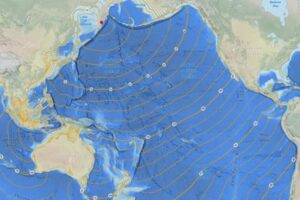
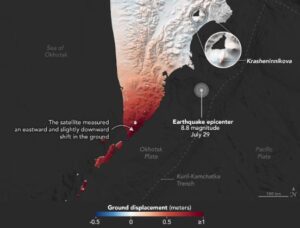
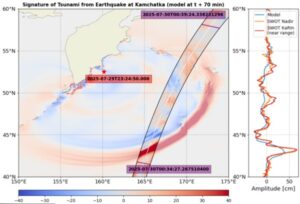
- The above visual maps indicate the areas of probable wave spreading, tsunami possibilities and land movement. The spread of the tsunami waves through the Pacific on one of the maps reveals the past occurrence of tsunami waves in Kamchatka. Another display where submarine fault/slip models show displacement (of significance in the risk of tsunami). The maps of the travel time indicate the period the waves of the quake may travel along the coastline.
- Models of previous tsunamis (such as Kamchatka quake of 1952) indicate that the run-ups (wave heights) are stronger in some locations (Kamchatka Islands, South Kamchatka) than in others. This disproportionate occurrence is highly reliant on the shape of coasts, bathymetry (shape of ocean bottom) and structure of faults.
- There is nowcasting on the go: the real-time quake information, post-shock relative patterns, slip models, are being used to estimate the probability in another large quake or hazardous waves. The emergency response and warnings are informed by these tools.
Conclusion
The recent magnitude 7.8 earthquake that hit the Kamchatka Peninsula of Russia is a sharp reminder of the unstable seismic activity that is exhibited by the region along the Pacific ring of fire. Although the warnings of tsunami caused a great panic among the population of coastal Russia, Kuril Islands, and even in the Pacific, the threat was lowered shortly. Luckily, there have not been any large numbers of people affected or devastating destruction reported, but small shaking effects, small waves and aftershocks have been rocking the inhabitants.
This occurrence is highlighted by experts and it is probable that this is a major aftershock of the previous M8.8 quake in July of 2025, since the fault line in this region remains unstable. Although the greatest risks of the world tsunami have been eliminated, the quake highlights the susceptibility of the coastal settlements, the infrastructure, and the people residing along the seismic hot zones.
Today, Kamchatka is on watch of aftershocks, local landslides and other secondary hazards, however, the handling of the emergency and early-warning systems has enabled it to avoid panic and limit the level of damage. The incident affirms the significance of readiness, unremitting vigilance and global collaboration in dealing with seismic hazards at the Pacific basin.