

Learn the story behind Epic killer Los Angeles rams since 1936 and their win of the super Bowl in St. Louis and Los Angeles. Learn about the legendary players, iconic times, and the overall influence of the franchise on the NFL.

Early Years in Cleveland (1936–1945)
- History: The Rams were started in 1936 in Cleveland, Ohio by an attorney known as Homer Marshman and a coach Damon Wetzel.
- The team started playing in the brief American Football League (AFL) in 1936, but relocated to the NFL in 1937.
- First, the Rams had attendance and performance problems.
- The Rams won their first NFL Championship in 1945 under the leadership of quarterback Bob Waterfield (who won league MVP), beating the Washington Redskins 15-14.
Move to Los Angeles (1946–1994)
- During 1945 championship, the team owner Dan Reeves moved the franchise to Los Angeles making the Rams the first NFL team housed on the West Coast.
- The relocation was also strategic in the national expansion of NFL.
1940s–1950s: Rise of the Rams
- Later in 1948, the Rams were the first NFL team to integrate, as it signed African American players Kenny Washington and Woody Strode.
- They also brought about the modern football entertainment where cheerleaders and a marching band until then was seen as modern.
- The Rams were the champions of NFL in 1951, defeating the Cleveland Browns 24-17 with their main quarter back Norm Van Brocklin and Elroy Crazylegs Hirsch.
1960s–1970s: “Fearsome Foursome” Era
- The defensive line of the Rams in the 1960s, the Fearsome Foursome (Deacon Jones, Merlin Olsen, Rosey Grier, and Lamar Lundy), was one of the strongest defensive lines in the history of NFL football.
- No Super Bowl in this era In spite of great teams, the Rams never managed to reach the Super Bowl.
1980s: Success and Relocation Looms.
- Under coach John Robinson and featuring the likes of Eric Dickerson (the NFL leader in single-season rushing with 2,105 yards in 1984) the Rams were perennial playoff participants.
- They also made it to the 1989 NFC Championship Game but defeated by San Francisco 49ers.
- Facts: By the early 1990s, attendance and stadium problems had raised the issue of relocation.


St. Louis Rams Era (1995–2015)
- In 1995, the owner Georgia Frontiere relocated Rams to St. Louis, Missouri.
- Their new home was the Trans World Dome (now, the Edward Jones Dome).
1999–2001: “The Greatest Show on Turf”
- To the credit of head coach Dick Vermeil and offensive coordinator Mike Martz, they were able to develop one of the most potent offenses in NFL history.
- Rams became legendary with quarterback Kurt Warner, running back Marshall Faulk and the receivers Isaac Bruce and Torry Holt.
- In 1999 (Super Bowl XXXIV), the Rams won over Tennessee Titans by a margin of 23 goals to 16, and the infamous One Yard Short finish.
- Only they made it back to the Super Bowl in 2001 where they were defeated by the New England Patriots in the first championship of Tom Brady.
2000s Decline
- The Rams went down after the success in the early 2000s because of injuries, change of coach, and turnover in the team.
- In 2004 to 2015 they did not record a winning record.

Return to Los Angeles (2016-2017)
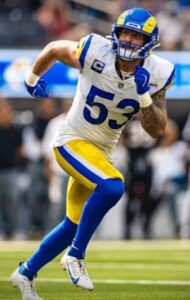
- Stan Kroenke, who owns the team, returned the team to Los Angeles in 2016.
- The Rams first played at the Los Angeles Memorial Coliseum until their new stadium was being built.
Sean McVay Era (2017–present)
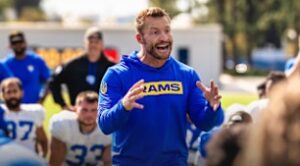
- In 2017, Rams employed the youngest head coach in the history of the modern NFL, Sean McVay.
- McVay made the team into contenders in a very short time.
- 2018 Season:
o The Rams made it to Super Bowl LIII but were defeated by the New England Patriots 13-3.
- 2021 Season (Super Bowl LVI):
o Under quarterback Matthew Stafford, receiver Cooper Kupp (receiving triple crown, Super Bowl MVP winner), and defensive superstars, such as Aaron Donald and Von Miller, the Rams fell to Cincinnati Bengals 23-20.
o This was their initial Super Bowl in Los Angeles (second in total).
SoFi Stadium Era
- In 2020, the Rams relocated to their new stadium, SoFi stadium, a $5 billion modern stadium in Inglewood, California.
- Also the stadium has hosted Super Bowl LVI which was won by the Rams, making the franchise a part of LA sports history.
Franchise Legacy
- 38 world championships: 3 NFL championships (1945, 1951, 1999, 2021 Super Bowl).
- Hall of Famers: The number of them is numerous, and they include Deacon Jones, Merlin Olsen, Eric Dickerson, Kurt Warner, Marshall Faulk, and Isaac Bruce.
- Renowned as an innovator of integration, offensive innovation (Greatest Show on Turf), and a dominant defensive ability (Fearsome Foursome).
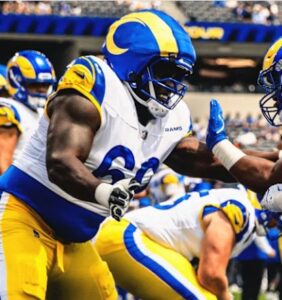

A relative rarity in NFL history, the Los Angeles Rams have been a champion in three cities Cleveland, St. Louis and Los Angeles.
Conclusion
The Los Angeles Rams history is a case of perseverance, creativity and a significant contribution to the NFL. The franchise has been able to influence professional football since its humble inception in Cleveland in 1936, up until the present day when it has dominated Los Angeles. The initial battles were replaced by success as they won the first NFL title in 1945 under Bob Waterfield and this was the starting point of competitive excellence.
It proved to be a landmark change in 1946 when the Rams became the first NFL team to move to the West Coast and the very first modern football entertainment with the inclusion of African American athletes and the introduction of cheerleading teams and marching bands. The Fearsome Foursome of the 1960s saw one of the strongest defensive units in NFL history that put the team on the defensive dominance stage, although it never won a Super Bowl.
In 1995, the team was renewed with success, after relocating to St. Louis, its brightest moment being the so-called Greatest Show on Turf offense, which consisted of Kurt Warner and Marshall Faulk, which led to the legendary victory of the team in Super Bowl XXXIV. Despite the downturn in the early 2000s, the Rams returned to Los Angeles in 2016, and the emergence of Sean McVay affected the franchise positively.
Its highest point was a 2021 Super Bowl LVI victory in the SoFi Stadium, which solidifies the position of the Rams as one of the most iconic and powerful NFL teams of all time. Having several championships, Hall of Famers and game changers in the field of integration, offense and defense, the Los Angeles Rams are one of the rarest NFL teams that have left a mark on the sport and its supporters.