

Learn about Foxtron models, global partnerships, and the entry of Foxconn EV through its MIH platform. Get to know its strengths, weaknesses, opportunities and challenges as it strives to secure 5 percent of the global EV market by the year 2025.

What Is Foxconn Doing in the EV Space?
Foxconn EV Strategy: It is not a Manufacturer, but a Platform Innovator.
- Platform Development (MIH): Foxconn unveiled the open-source MIH electric vehicle platform a system it describes as a modular and software-defined system designed to be flexible in form factors and drive. It distributes solid-state batteries, OTA updates and bespoke EV kits to manufacturers.
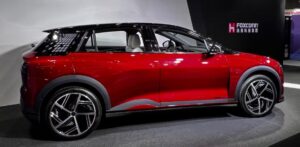
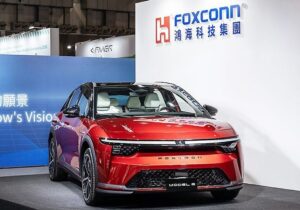
- Prototypes, such as the Model C (SUV), Model E (sedan) and Model T (bus) were on display to demonstrate the capabilities of MIH, but these models were mostly reference designs instead of products to be sold to the consumer.
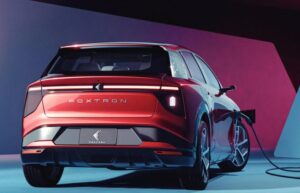
- Foxtron (a JV with Yulon Motor) has been the heart of this effort, as the EV division of Foxconn and has partnered with automotive organizations locally and abroad.

| Model | Type | Highlights |
| Model C (Foxtron SUV) | Mid-size crossover | 0.27 drag coefficient, 0–100 km/h in 3.8 sec, ~700 km range (~435 mi) |
| Model E | Luxury sedan | ~750 hp, 0–100 km/h in ~2.8 sec, ~750 km (~466 mi) range, mobile-office rear seat |
| Model T | Electric bus | 400 kWh battery, first delivered in Taiwan (2022), Good Design Award winner |
| Model B & Model D / U | Crossover / MPV / Urban Bus | Model B: compact crossover (0.26 drag, 450 km range); Model D: 5.2 m LMUV with adjustable suspension; Model U: urban mini-bus |
Expansion Plans
- North America: The Model C will be exported to the U.S. at the end of 2025 and the bigger Model D is to be rolled out by 2027.
- Asia-Pacific (Australia/New Zealand): Mitsubishi Motors is developing a Foxtron EV model that should be introduced in those markets in 2026. Design and manufacturing will be done by Foxtron, which will be based in Taiwan.
- Global Ambitions: Foxconn is looking to secure approximately 5 percent of the total EV market by 2025, with an annual OEM capacity of 500,000 to 750,000 vehicles.
Strategic Partnerships
- Mitsubishi Motors: Foxtron is under the MOU to manufacture EVs to be sold by Mitsubishi, mostly in Oceania.
- Japanese Automakers: Foxconn has been keen on working with Nissan and Honda on the development of EVs, particularly following the failure of the HondaNissan merger and acquisition.

Summary
You must make Foxconn a stakeholder in the electrified future–by:
- Development of an open and modular EV platform (MIH).
- The ability to show a variety in the vehicles (Models C, E, T, B, D, U).
- Building strategic OEMs (especially Mitsubishi in 2026)
- Focus on international growth such as North America and Asia-Pacific.
Strengths
- Manufacturing Powerhouse: 40 years of experience in mass production of high-volume electronics at low costs.
- MIH Open Platform: An open platform that allows automakers to easily adopt, customize and accelerate the development of EVs.
- Diverse Series of Prototypes: Sedans (Model E) to SUV (Model C), buses (Model T) to crossovers (Model B).
- Global: Relations with Mitsubishi Motors, Nissan and Honda interest, and current JV with Yulon Motor (Foxtron).
- Electronics Knowledge: Excellent battery, semiconductor and software integration, which software-defined EVs need.


Weaknesses
- Novice in Automobile Industry: No long history as the old automakers (Toyota, VW, Tesla).
- Brand Recognition in Cars: Foxconn is not a car company in the eyes of the consumers yet.
- Relying on Collaborators: Still continues to use the services of already established automakers as a means to both gaining credibility and market share.
- Large R&D Investments: EV competition forces massive, long-term investment- you might not make super-profits in the early years.
Opportunities
- Higher EV Demand Government incentives toward zero-emission policies (U.S., Europe, China, Japan).
- Other trends in OEM outsourcing OEMs: Auto manufacturers are seeking to outsource the manufacturing of EVs, as they did with electronics.
- New market entry: U.S., Oceania and Asia-Pacific development strategy provides it with international presence.
- Software-Defined Vehicles: Foxconn has a history of working with chips, AI, and electronics, which can contribute to the design of smart cars.
- First-Mover Benefits in EV Outsourcing: May be the next iPhones by establishing itself as an EV Foxconn to several manufacturers.
Threats
- Very High Competition: Tesla, BYD, Volkswagen, Hyundai, and new Chinese startups.
- Technological Risk: Foxconn will not be able to maintain the roadmap because of the rapid changes (solid-state batteries, autonomous driving).
- Supply Chain Volatility: The lithium cobalt battery material shortage or rise in the prices can slow down the progress.
- Regulatory: It is expensive to comply with high safety and emission requirements in each market.
- Brand Risk: In case the EVs produced by Foxconn fail, it may damage reputation with collaborating brands.
Bottom Line:
Foxconn has the size, electronics expertise, and relationships to be a significant EV contract manufacturer. However, it needs to achieve success through establishing a reputation of quality, developing an automotive identity, and remaining in the lead of the rapidly developing EV technology.
Also read- Acura RSX EV