
Defense Secretary Pete Hegseth instantly orders 100s US Military officers worldwide (i.e. generals and admirals) to a meeting next week at Quantico, Virginia on extremely short notice.
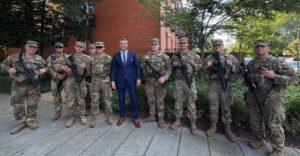
What it has proven in the reporting recently:
- Hegseth has given hundreds of U.S. generals and admirals (senior military brass) short notice to meet in Quantico, Virginia.
- In fact, the directive is unusually odd, and it has puzzled the military leadership circles due to the fact that the purpose of the meeting was not publicly declared.
- Sure, he has also advocated the reduction in the number of high-ranking officers: e.g. 20 per cent cut in four-star posts and other cuts at general/flag officer ranks.
What is reported
- Scope & scale: the order is reported to have contained hundreds of the general- and flag-officers, together with their senior enlisted advisers.
- International destinations: A large percentage of these officers are deployed in foreign countries and in isolated operations (e.g. in East Asia, in the Middle East). It is said that their schedules are being destabilized.
- Short notice & secrecy: Little prior notice and no public agenda has been made known.
- Pentagon reaction: The Pentagon is not very vocal in its reaction. Spokesperson (Sean Parnell) confirmed that the Secretary of War (i.e. Hegseth) will be meeting with his senior military leaders early next week but refused to give specifics.
- Theory and fear: Analysts, ex-police officers and the press lament or worry – about the sheer size and rapidity of it being highly deviant and counter-productive, and that secure communications could have been made in other ways, without putting hundreds of the top officers in the air.
Caveats & unknowns
- Even the reason why the meeting is being convened: The overarching question, why the meeting is being convened, will not be publicly answered.
- Attendance and logistics: It is not clear how many people will attend, the viability of commanders in high-risk assigning overseas posts to leave their posts, and everybody obeying.
- Precedent & novelty: Reports highlight that this sort of gathering, bringing senior commanders together in various places around the world with very little warning and no announced agenda, is highly unusual, almost unheard of in the last several decades.
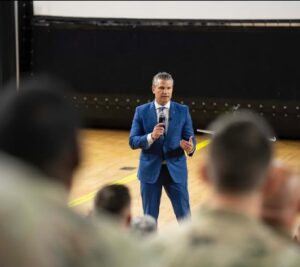
Challenges, Strategic Concerns and Risks.
On top of the purpose that the meeting may have, analysts alert of a number of complications:
- Command gaps overseas
A good number of senior officers will be out of office on a temporary basis and their commands might be run by acting officers. That may slow down nimbleness or decision-making in volatile regions or because of crisis.
- Security risk & concentration risk.
The fact that hundreds of top-level military officials have been gathered together is a high-value target in itself. A significant logistical and cybersecurity issue is to make sure that the communications are safe, the physical location is safe, and the transit is safe.
- Interruption of planned functions and operations.
Most of these officers have active operation obligations, foreign activities, or time bound obligations. The change at the last moment disrupts these schedules.
- Politicization Perception.
Since Hegseth has already swept the personnel and potentially controversial changes, this meeting can be viewed by some critics as more of a political than a strategic act – increasing tensions between civilian leadership and the military caste.
- Deficit of transparency/ morale impacts.
This secretiveness of the order, absence of an agenda, and lack of certainty have allegedly thrown many of the officers called to task into some state of uncertainty. In case officers are blindsided they might undermine trust.
- Political / congressional backlash.
Congress may seek clarification, scrutiny, or opposition particularly when decisions made or reported there seem to go beyond or circumvent consultation.
Comparisons and Analogies in History.
- The Last Supper -1993 Pentagon Dinner with Defense Contractors.
In 1993, the then-secretary of defense Les Aspin organized a top-secret dinner at the pentagon with the heads of the large defense companies to mark the impending merger in the defense sector. This incident was popularly referred to as the Last Supper.
- Parallel: It was a surprise meeting as those who were invited knew the agenda upon arrival.
- Diffidence: This was civilian leadership that summoned industry leaders (not military leaders), and the number was far smaller. The situation was in the post-Cold War budget cuts.
- Lesson: It demonstrates how secret, high-stakes meetings have been employed as a means of indicating dramatic changes (in that instance, industry consolidation).
- Pentagon Town Halls / frequent top meetings.
Town halls or summits with top level leadership of the military are periodically held by the Secretary of Defense, particularly with major policy launches or when the organization is undergoing some changes. As an example, in March of 2003, Secretary Rumsfeld conducted a pentagon town hall meeting with top defense officials and service leaders.
- Parallel: These meetings are employed to convey doctrine, expectations or transitions between the civilian leadership and the military leadership.
- Difference: These incidents are usually predicted (albeit not entirely open) and carried out on a controllable level; they are not spontaneous mass withdrawals of leaders in the international assignment.
- Command/ Staff Realignments / Organizational Overhauls.
In the U.S. military history, significant restructurings, by way of example, Goldwater-Nichols (1986), acquisitions reforms, or post-cold war downsizing have necessitated top-level gatherings. Although these seldom transfer all the generals of the foreign army suddenly, major commanders are often called to strategy conferences.
- Parallel: These reforms offer precedence in calling senior leadership to be in line regarding doctrine, roles or structural changes.
- Difference: These reorganizations are normally several months long; they are planned and staged to have the least impact on the operation.
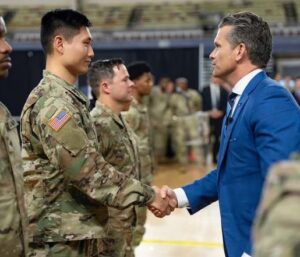
What Lessons Analysts Learn and What to Be Careful of.
Based on previous examples and organizational theory, observers provide a warning that:
- Messaging issues: Leadership summoning in secrecy, First impression generally defines morale and trust. Lack of preliminary setting can create suspicion.
- Continuity should be ensured: The loss of operational capability of theaters during the movement of the leaders may cause temporary weaknesses in leadership.
- Substitutes: There are Substitutes in the contemporary times, there are secure videoconferencing and distributed decision networks that do not necessitate mass physical assembly. The opponents are already quick to note that virtual mechanisms would have worked in most instances.
- Optics with Congress and media: Since such a move is so uncharacteristic, it will be attacked by the population and Congress, in particular, particularly in case this meeting is accompanied by sudden dismissals or changes in policy.
- The risk of institutional memory loss: In case this gathering is a precursor of wholesale retirements or even purges, the military would lose institutional experience.
- Historic trust relations: Reforms in the military done in the past, were frequently easier to implement when the consensus or inclusion of stakeholders was applied; unexpected top-down orders are relatively contrary.
Also read- Author Voddie Baucham dead at 56


2z4y10