

The Magical Orionid meteor shower 2025 will be unbelievable and will reach its climax on October 21-23. See brilliant sparkling meteors of Halley Comet glowing blisteringly.

Introduction
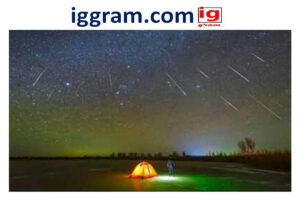
The Orionids are considered to be one of the most beautiful displays of meteors which happens in the sky every year during the month of October when stargazers all over the world observe it. Orionids meteor shower is a result of dust and debris left behind by the Halley Comet and in 2025 the event will be particularly good. This article you will read now will tell you the causes of the Orionids and the time and place to see them, the best way to see them, and the answers to the most asked questions.
Why is the Orionids Meteor Shower?
The Orionids take place as the earth crashes through the trail of debris that was left by Halley Comet after centuries. The meteoroids come in our atmosphere at varying speeds of approximately 66 km/s (approximately 41 miles per second) according to NASA, so, they are one of the fastest of the year.
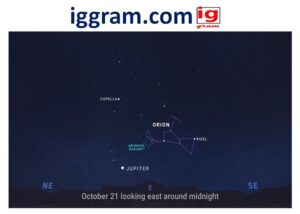
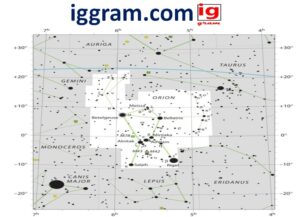
The brightest ( apparent point-of-origin ) of the Orionids is in the constellation Orion – that is why they are called Orionids. However, the meteors are able to run across the sky in a wide range of directions not necessarily in the direction of Orion.
Due to this cause, the Orionids are among two large showers with which Halley’s Comet is associated (the other one is Eta Aquariids in May).
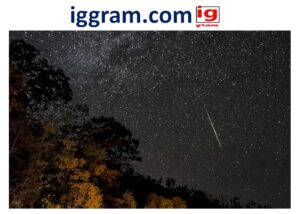

When and Where to See the 2025 Orionids.
Active period: The period spans between October 2, 2025 November 12, 2025.
Peak dates: According to a number of sources, the nights of October 20-23, 2025 are going to be the most favourable, although especially the night of October 21.
Due to the fact that the Moon in the peak is very thin (a new-moon phase), the conditions in the sky will be darker than in many years – perfect to look at meteors.
Where: The orionids can be seen in almost all inhabited latitudes (both Northern and Southern Hemispheres).
Optimal night time: Once the brilliant in Orion comes out (that is, it comes up after midnight, about the time of the local time) until just before daybreak. The deeper the radiant will rise beyond the horizon, the more the meteors will then possibly be seen.
Direction: Although it seems that the meteors are approaching the area of Orion, you are also advised to recline and view a broad area of the sky. To the south east, aiming roughly south east, on the Northern hemisphere, Northeast, aiming Northeast on the Southern hemisphere.

Why the Orionids Are Special
- Speed & trains: Due to the high speed (up to 66 km/s) at which the meteoroids hit our atmosphere they frequently make plumbing trains (trains of glowing debris that last a few seconds) or fireballs.
- Backdrop stars: The luminous is in close proximity to some of the brightest stars in the sky (e.g. the orange star Betelgeuse in Orion) providing a dramatic in-the-sky backdrop.
- Good visibility in 2025: 2025 will be a better year to watch the show since the moonlight will not significantly cause any distortion as it has spoiled the show on other years.
Watching Advice How to get the most meteors.
- Go dark: Find a place not in the light of the city or street-lights. The blacker the sky the more meteors you will have.
- Let your eyes adapt: Take 20- 30 minutes to be able to see well in the dark.
- Basically: lying on the back if you are on a blanket, on a reclining chair. It is not just the radiant that should be looked at, but there are lots of meteors that can be seen at a steep angle of the radiant.
- Take care: Wear a warm-up, a blanket, a hot beverage, and a pillow perhaps, you will spend several hours there.
- Wait patiently: The waiting game in meteor showers. Up to 10-20 meteors/hour could be viewed only in good conditions; at best conditions could be 20-30.
- Weather check: It is essential that the weather is clear. The fact that the meteor shower is on does not mean that the visibility has not been killed by the clouds.
- Photography: If you feel like: Wide-angle lens, tripod and the use of the long exposure- setting, point the camera somewhat off-center of Orion, this will create longer meteor trails.

Expectancies: Rates of Meteors and Stability.
In optimal conditions (radiant high, dark sky) the Orionids can usually produce between 10-20 meteors an hour at a time. There were a few years when 30-50 meteors per hour were documented.
Due to the breadth of the meteor stream and the fact that the Earth passes through multiple pieces of debris, activity peaks can be slightly differentiated according to the place and hour. Therefore when you fail to get one night, you might still have a good day the next morning.
FAQs (Frequently Asked Questions).
Q: Do I have to wear a telescope or a pair of glasses to view the orionids?
A: No. The Orionids are best viewed with naked eye – there are a lot of meteors pass through the sky far above the horizon and the use of the optics only narrows your opinion.
Q: Will the Moon interfere this year?
A: The peak in 2025 is actually a new moon (or very thin crescent) and that is why the moonlight will have the least amount of interference with the visibility hence this year is particularly good.
Q: Am I going to see the shooting stars in the town or I have to drive?
A: You could see meteors in the suburban or even urban skies, but the light pollution will significantly cut down the number of meteors that you will see. To enjoy it, one can definitely recommend visiting a dark secluded place.
Q: Which time is the most appropriate to watch?
A: Go early, in the morning (before it gets late, i.e., after midnight) when the constellation of Orion is higher in the sky laboring (typically 1:00 a.m. local time and further on) and before daybreak. Things are favourable when the radiant is elevated.
Q: Is it possible to take photos of the Orionids?
A: Yes. You are going to use a wide-angle lens, heavy tripod, high ISO (depending on your camera) and also long exposure (20-30 seconds) but facing slightly off-centre to Orion so as to increase the chances to record meteor streaks. Either switch off additional lighting, or perhaps add an element to the foreground.
Final Thoughts
The Orionids meteor shower is still a fall sight to be seen by both the sky watchers and the amateur stargazers. It has got very fast and bright meteors, dramatic background, and good performance in 2025, due to favourable noon time exposed moon conditions, so it is a good year to arrange a meteor-watching party. No matter what side of the globe you are on, all that you need is dark skies, comfort, patience and letting your eyes wander long distances across the heavens.
Set your alarm, take a blanket and find a place that is not lighted by the metropolis and gaze. The world will perform its performance.
Also read- Exposed 5 step’s What Is Climate Change?