

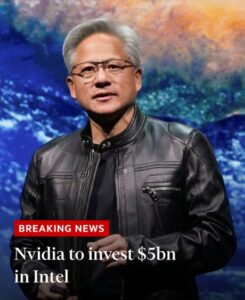
Nvidia’s Boost $5bn stake in Intel , Nvidia has invested in Intel up to the tune of 5 billion dollars acquiring a five percent stake at a price of 23.28 per share. The historic transaction will advance tailor made CPUs, system-on-a-chip, and data center offerings that merge Intel x86 platform with Nvidia RTX GPUs and NVLink links.

Although the alliance provides Intel with new funds and reputation during crises in the fields of AI and production, it also increases the presence of Nvidia within the CPU-GPU ecosystem. Analysts interpret the move as a re-alignment of strategies that may strangle AMD and TSMC even though implementation risks and regulatory reviews and foundry insecurities exist.
What the deal is
- Nvidia is acquisition of Intel common stock of value 5 billion dollars at 23.28 dollars per share.
- This will give Nvidia about a 4 percent holding in Intel.
- The investment will be approved by regulations.
What they plan to do together
- The two businesses will cooperate in coming up with bespoke CPUs and system-on-chip (SOC):
– In case of data centers, Intel will develop bespoke x86 processors that are compatible with AI infrastructure of Nvidia.
– In the case of PCs, they will be operating on x86 SoCs which will be fitted with Nvidia RTX GPU chiplets.
- They will connect the CPU-GPU combinations with the NVLink (high-speed interconnect technology by Nvidia) closely.

Context and motivations
- Intel is in distress: loss, losing its lead in production and artificial intelligence acceleration, etc.
- The move is a win to Intel: both in terms of financial resources and in terms of shaping it into a more symbiotic relationship with the dominant AI ecosystem of Nvidia.
- In the case of Nvidia, it would assist in establishing further dominance of the CPU + GPU / AI stack, with more influence on how its AI systems and chips are combined in the x86 architecture.
Effects in the market
- The news raised Intel stock hugely (an average of 23-24% in one day).
- Nvidia shares also increased (in a lesser magnitude yet positive).
Open questions/ things to watch.
- It is not evident whether Intel foundry/manufacturing business is included in this deal. According to the current reports, Intel Foundry is out of scope.
- The extent to which the new advanced process technologies (such as the next 14A node) of Intel will be integrated into the partnership is yet to be observed. Other analysts believe that the deal will indirectly favor the Intel next-gen fab demand.
- Regulatory issues: as both are giant semiconductor firms, and this will be inter-company collaboration, it might be not so easy to get approvals.

Expert & Analyst Views
- Sentiment Shift for Intel
o Nvidia has made a move that has been perceived as a show of confidence by many analysts towards Intel. Investor sentiment has increased greatly based on the promise of developing the joint chip with investment.
This is a game changer as seen by Vital tech analysts like the ones with Wedbush as it will allow Intel to re-enter the AI infrastructure race with greater credibility.
- Foundry and Manufacturing Prospects at Intel.
o The next process node of Intel (14A, targeted at circa 2027) would receive a huge boost of the committed product demand through this partnership. Analysts suppose that this demand assists in assuring market and shareholders that Intel is capable of making its advanced nodes work.
o With that said, Nvidia has not bet on Intel foundry on its flagship chips at least not wholesale; they will be the CPUs, fancy packages etc., but there is still the risk of the foundry.
- Competitive Pressure on AMD, TSMC etc.
o AMD might pose a threat to Portland competitors in the case of performance or cost advantage due to closer integration of Intel + Nvidia.
TSMC could lose part of the business in case any part of the supply of Nvidia of the GPUs/AI chip products are shifted (or are intended to be shifted) to Intel to package or integrate with the CPU. The latter threat is however muted by the fact that Nvidia continues to heavily use TSMC and can not easily switch.
- Risks & Doubts
o High capital requirements: Intel has been wasting money, it has experienced profitability problems and requires additional investment. It may not require a single huge investment of 5B to restore all the competitive gaps. According to some analysts, more investment or partnerships will be required to be made in Intel.
o Complexity to execute: Incorporating chiplets of the GPU chip, creating data center CPUs that work well with the Nvidia GPU/AI stack, and in particular fulfilling future process nodes all are difficult. Any slip-ups or failure to move fast enough would compromise the competitive edge.
o Regulatory & strategic risks: Since this is a joint venture between two big players, regulatory focus may be given on the extent to which the relationship becomes integrated or whether one of the parties acquires too much power. There is also a risk of supply chain, intellectual property etc. Certain analysts question how far Intel will dominate over or how far it will yield to the preferences of the architecture of Nvidia.

Conclusion
One of the most unexpected and strategically important actions in the semiconductor industry in the recent years is the unprecedented 5 billion dollar investment of Nvidia in Intel. In the case of Intel, this acquisition not only gives the company a much-needed capital injection but also sends a message to the rest of the world that Intel still has so much to offer in its know-how of constructing and producing the CPU. Through the partnership to design more custom CPUs, SoCs and next-generation data center solutions, the opportunity exists to help Intel refocus its roadmap based on the fast-growing AI ecosystem.
In the case of Nvidia, the investment does not focus on financial values but on the positioning. Through this alliances, Nvidia will have better access to x86 CPUs, which remain the heart of both PCs and servers, and access ways to manipulate the advanced packaging and future process nodes of Intel. This combination makes Nvidia even stronger in AI stack, which is already leading, and it becomes the center of the high-performance computing ecosystems.
Nevertheless, the collaboration also brings up some concerns. Will Intelligent Intel be able to keep to its advanced node promises and rejoin the manufacturing leadership? Will the regulators examine the transaction as an anti-competitive one involving combined market power of two industry giants? So what will happen to the competition of AMD, TSMC and ARM-based chipmakers in the wake of this unlikely merger?
After all, this deal is a new beginning: Intel needs a new life, Nvidia wants to have more control over the ecosystem and the semiconductor industry in general is exposed to a new competitive pressures. When done properly, the cooperation can alter the balance of power in AI computing, data centers, and next-generation PC design, however, the chances of missed steps during execution and regulatory obstructions are high.
Also read- Proven , Bill Ackman’s main fund doubles to $9.2 billion in 2025