

opinion on Fed’s interest rates cut by the economists about the recent interest rate cuts made by the Fed and how it is likely to be in the next 12-18 months. The best information to be presented in this analysis will be best case scenarios, base-case scenarios, and worst-case scenarios with potential shock effects on the inflation, unemployment, borrowing factors, housing and financial markets. Learn how the Fed has to balance slowing the growth against a sustained high level of inflation, and what data the Fed will use to make the next change in the monetary policy.
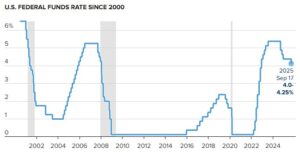

What just happened
- Federal Reserve reduced the federal funds rate by 25 basis points, to 4.00% -4.25%, the first time in seven months.
- The Fed indicated a second and, possibly, a third cut this year (in separate meetings on courses in October and December) but said that nothing is certain and that choices will be made depending on the change in data.
- Significant reasons: a weaker labor market, indicators of slow economic growth, as inflation is at a level above the mark (approximately at 2.9), though slightly declining.
What Might Wise Off / Things to Notice.
These are some conditions and incitement that may push things up and down, and what to have an eye on.
- Further rate cuts
Should economic information (jobs, wages, consumer spending) keep decline, the Fed can stick to its view of an additional two cuts in 2025.
Nevertheless, in the event that inflation continues being sticky or it increases once more, the Fed may postpone or reduce cuts.
- Market reactions & sentiment
o Important are the investor expectations. However, when the forward guidance of the Fed is more dovish (i.e. hopeful that cuts and in its support), then that can strengthen markets. The markets may get disillusioned should there be an indication of risk (as in the case of inflation fears, or poor consumer demand) or a spotting of this danger.
o Inflation expectations Continue to monitor the bond market (yields on the 10-year Treasury etc.), and in that case, yields will go up (allowing the rate cut to be neutralized).
- Labor market trends
They’re a major trigger. In case of a loss in job growth, more layoffs or at least some increment in unemployment, the need to keep expanding pressure will arise. In case however, the hiring choices are again, wage growth will continue to be robust, that may change the balance of Fed back to fighting inflation.
- Inflation statistics / supply side pressures.
Core inflation, the expectations of inflation, restriction in supplies, prices of commodities, tariffs, in all of them, they are risks. In case inflation continues to exceed target (or cycles back), the Fed will spark off further reduction or even a stagnation.
- Global & external shocks
o This strategy could be changed by external events (as world economic slow down, trade wars, energy shock, etc).
o Likewise, in case other central banks change, tightening or loosening, this affects the capital flows, then in turn, the exchange rates which propagate into the cost of inflation/importation.
- Political & regulation stress.
Fed to a certain extent enjoys political attention. But preserving independence is believed to be significant in regard to credibility. To the extent that there is greater political interference, this may have an impact on confidence that markets have in Fed judgments.

Risks & Potential Downsides
- inflation: If the demand grows faster than the supply problem is addressed due to the rate cuts, it is possible that the inflation will remain high or reach even higher levels.
- Credibility of Central Bank: When markets feel that the Fed can easily be influenced or even when they doubt his/her commitment to control inflation, de-anchoring of inflation expectations may occur which is expensive.
- Implemented too late and/or too much: The risks associated with it are that by reducing rates, it may still not it maintain a tight, unsustained economic slowdown or recession.
- Asset bubbles: Easy money will drive risk in mortgages markets, stock markets, or other asset markets.

Key Inputs / Assumptions
Influencing forecasts before the scenarios are key inputs of the following nature:
- Life is still above target ( lacking) inflation (~2-3%), but with some signs of easing. Core inflation / PCE remains an issue.
- Labor market is becoming weak: unemployment rates are rising, hiring is decreasing.
- More failsafe, in countless projections Fed has passed the passage indicating there would be two additional 25bp reductions in 2025 (Oct and Dec). However, there are numerous forecasts different in 2026.


What A Particular Oscarion /Charlie Ifarethanalyststhink.
- Nomura has revisited the position to anticipate cutting nature with regards to 25 bp in both October and December 2025.
- Depending on the softening of inflation, Morgan Stanley now anticipates 4 consecutive 25 bp cuts (so further easing) over a longer time.
- The own summary of Economic Projections (fed / dot plot) provided by Fed states the median of their projection which implies a slight reliebation, the projected level of the Component Used by the fed funds rate in 2025 is lower than it currently stands though not drastically. By the end of 2025, the median FOMC projects funds to be close to 3.6%.
Conclusion
The last act by the Federal Reserve to lower its interest rates is a revolutionary move to the monetary policy that indicates a change of risk balance away towards inflation and low growth as well as hard labour market. As much as the markets have responded well to the first step, the future remains unclear, and it will be largely based on the direction of inflation, unemployment, and economic stability of the world.
To the optimistic side; the inflation keeps calming and the labor market decelerates slowly because the Fed will have the space to drop the rate step by step by 2025 and 2026. This will help in consumer expenditure, easing credit market and will offer the economy a soft landing.
Base case in which inflation will be falling slower leaves the Fed wary and slow. In this route, the rates are reduced, but not immediately but overtime making financial conditions rather constrained until inflation is well tamed.
A slow or even backward-looking inflation, as well as a more negativistic fall in the labor market or external shock, are the worst. In such an affair, Fed might be compelled to cease any further reductions (or even raise interest rates once more) at the expense of falling deeper into a more agonizing recession and exposing markets to greater instability.
The Fed faces a difficult task that it can sustain a fine balancing act and to give the economy enough monetary body to avoid future slowdown but at the same time not to give inflation expectations any grounds to leave their anchors. The period of 12-18 months will be the game changer with every inflation and labor market report releasing the interests rates might either alter the interest rate dependence as to whether the U.S. economy will experience a soft landing or sink into recession.
Also read- The truth about Musk buys shares worth about $1B of Tesla