
Top 5 mistakes after knee replacement surgery. Get professional advice on how to recover quicker, walk pain-free, and save your new knee in the long-run.
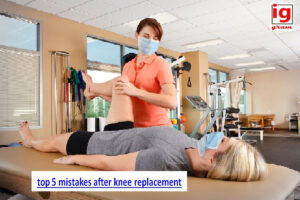
The 5 most common mistakes that occur after knee replacement and how to prevent them.
The knee replacement surgery may be a new beginning. You no longer have the pain that dictated your existence, and you are now just dreaming of walking long, not worrying about stairs, and getting a good sleep.
The thing is though that here is where many patients discover the hard way and that is that after knee replacement that happens is just as important as the actual surgery.
Thousands of individuals are postponing their healing each year or even causing harm to their new knee due to minimal and preventable errors. To make sure that you can recover fast, move well, and keep your new knee joint intact to enjoy a long life ahead, we will deconstruct the top 5 mistakes to make after knee replacement.
Mistake #1: Missing or Getting Half-Hearted Physical Therapy.
Physical therapy is not an option. It provides the basis of recovery.
Most patients prematurely terminate therapy or fail to challenge themselves (in a safe way) due to the uncomfortable nature of exercises. The indecisiveness can work against him/her.
Why this is a big problem
Knee replacement surgery is followed by the development of scar tissue. Without regular movement:
- The knee can become stiff
- The degree of mobility can be permanent.
- Walking, sitting and bending remain hard.
Others patients find themselves developing permanent stiffness on the basis that therapy was not taken seriously.
What to do instead
- Be at each of the scheduled physical therapy appointments.
- Do your house exercise every day even during low-energetics days.
- Be truthful about pain in order to make exercises more adaptive and not evasive.
It is long-term pain that is the result of short-term suffering.
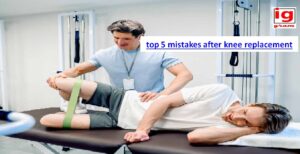
Mistake #2: Making the Biggest Mistakes Small.
On the other hand, individuals are too good and are overworked.
You may be walking well so you may think why not clean the house or go shopping. That’s a common trap.
Why hyperactivity retards the healing process.
What you have are muscles, ligaments and bone that are in the process of healing – even though the pain may seem to be under control. Overexertion can cause:
- Swelling and inflammation
- Increased pain the next day
- Slow improvement in physical therapy.
The recurring flares may lengthen the healing period weeks into months.
Smart recovery habits
- Adhere to the schedule of activities of your surgeon.
- Make things more active, not fast.
- Feedback with pain and swelling is not a challenge.
Healing isn’t a race. Consistency wins.
Mistake #3: Denial of Swelling, Pain or Red flags.
A certain amount of pain is expected following knee replacement. However, unusual symptoms should not be neglected.
There are too many patients who believe that everything is a part of the recovery process.
Red flags that should not be disregarded.
- Pain is progressive rather than progressive.
- Rubor criminale, dealbaltness, or discord Nobility swelling.
- Fever or chills
- Included in this are sudden sharp pain or clicking sensation.
These may indicate infection, blood clots or problems with the implants.
What you should do
- Track your symptoms daily
- Notice doctor of change in report on time.
- Self-diagnosis or wait and hope: no.
Proper steps at an early age will eliminate severe complications.
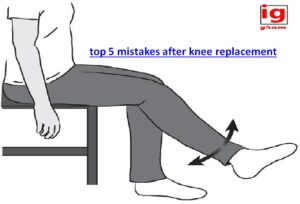
Mistake #4: Unwise Pain Management Decisions.
Pain management is not so much about comfort, but also, it influences movement, sleep, and recovery.
Other patients are over dependent on pain medications and some do not take them at all out of fear.
The impact of poor pain management on recovery.
- Excessive medication may lead to drowsiness, constipation or addiction.
- Excessive pain causes unbearable therapy.
- Sleep deprivation retards the repair of tissues.
Unmanaged pain can usually result in not completing exercises and slowing of progress.
Efforts to manage pain in an equal manner.
- Precisely taking of medications as prescribed.
- Combine this and pain relief with icing and elevation.
- Tapering of drugs gradually as mobility increases.
- The non-drug options should include compression or guided movement, which should be discussed.
Recovery should be supported by pain control – not controlled.
Mistake #5: Long-term Knee Neglected.
A lot of patients believe that recovery is over as they are able to walk normally. That is another expensive mistake.
Your fake knee is powerful, by it is not indefeasible.
Mistakes that harm new knees in the long run.
- Excess acquisition of weight, stress on the joints.
- Missing follow up appointments.
- Strength training should not be avoided after therapy.
- Severe exercises such as running or jumping.
These habits may lead to the eventual reduction of the lifespan of your knee implant.
Knee friendly when over the long-run.
- Eat well to keep body weight normal.
- Exercise regularly with low intensity such as swimming, cycling.
- Muscles of legs should be strong and stiff.
- Physically present at all checkups.
Properly maintained knee replacement is expected to last 15-20 or longer.
Online Journalism: What Recovery is Like in Everybody.
Different things can happen to two patients undergoing the same operation. Why?
Such variables as age, fitness before the surgery, attitude, and daily routine are all important. When patients remain active, tolerant and educated, they will heal at a accelerated rate and be in a better position to resume normal functioning.
It is not a perfection, it is intelligent permanent advance.
FAQs
- Which is the greatest knee replacement cement post-surgery mistake?
The most harmful and prevalent error is skipping or not being fully committed to physical therapy. It causes stiffness and lack of mobility often.
- What is the time of complete recovery after knee replacement?
The majority of the people will be experiencing significant improvement in 3 months yet they may need 6-12 months to heal completely based on the level of activity and the regularity of rehab.
- Is the presence of a swelling several months after knee replacement normal?
The mild swelling may linger in months particularly when activity occurs. Nevertheless, swelling up or swelling that is painful is to be considered by a physician.
- Will the knee replacement be harmed by walking excessively?
Yes. Overwalking before the time will result in inflammation and delayed healing. Gradual activity that is prescribed by your surgeon or therapist should be increased.
- What do you mean by exercises to avoid following knee replacement?
Strenuous activities such as running, jumping or contact sports ought to be avoided as a rule to avoid damaging the implant.
- What is the duration of exercises after the physical therapy is over?
Ideally, exercises to strengthen and be flexible must be a lifetime habit in order to maintain the health of the knee and the general mobility.
Final Thoughts:
Knee replacement surgery is a second probability of movement- but only when recovery is managed in a sound manner.
These are the 5 mistakes to avoid after knee replacement and may spell out the difference between chronic pain and permanent happiness. Learn to listen to your body and work with a professional and be consistent even on days when you lack motivation.
Your new knee is an investment. Take care of it—and it will take care of you.
Also read- Best 5 tips Baby roach get rid


1 thought on “Top 5 mistakes after knee replacement”