
Top of foot pain is such that every step is painful. And find out the most frequent causes, symptoms, treatment, and easy remedies.
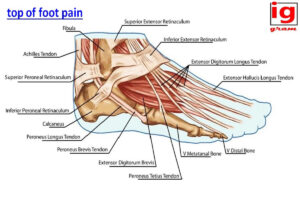
Foot Pain at the Top: What happens, Why, and What really works.
It was not the first time you felt that sharp ache on the top of your foot. You feel okay one day and the following day you are winking with each step. Top of foot pain is an unexpectedly widespread and misconceived. The good news? A majority of the causes are curable when you are aware of what you are dealing with.
With this guide, it is all in simple terms: what makes your foot sore when on top, What makes your symptoms important, and exactly how you can relieve yourself, with headaches, and without the book making it up to you.
What Is Top of Foot Pain?
The top of foot pain is defined as pain, tenderness or swelling on the top side of the foot, above the ankle and the toes. It may be tame and sore, and sharp and stabbing, or tight and burning,–according to the cause.
As compared to heel or arch pain, top of the foot pain usually presents with tendons, bones, nerves strained by movement, footwear, or even overuse.
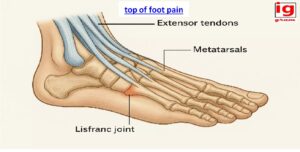
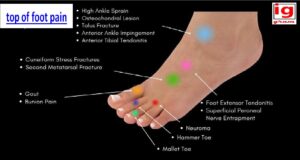
Top of the Foot Pain: Common Causes.
- Endoneurialitis and Endoneurium Tenodesis (Rare Cause).
Extensor tendons are located above your foot and they spring up your toes. When they are irritated or inflamed, they reveal pain quickly.
Typical triggers include:
- Tight shoes or laces
- Overwalking or running
- Sudden increase in activity
- Repetitive foot motion
Key symptoms:
- Worsening pain on movement, flexion of toes.
- Sensitivity on the anterior foot.
- Mild swelling
- Stress Fractures
Stress fracture is a small crack in a bone that results due to the repetitive force, not an abrupt injury.
Often seen in:
- Runners and athletes
- The individuals standing long hours.
- Those with low bone density
Warning signs:
- The onset of pain mild, which deteriorates with time.
- Topical edema of the foot.
- Later stage pain even at rest.
The results of disregarding this form of top of foot pain can be a complete fracture thus it is a good idea to take care of it early.
- Interaction of Nerves: Nerve Compression or Nerve Pain.
Pain can be sharp, electric or burning when nerves on the top of the foot are compressed and/or irritated.
Possible causes:
- Tight footwear
- Swelling from injury
- Nerve entrapment
You may notice:
- Tingling or numbness
- Shooting pain into toes
- Sensitivity to touch
- Foot Arthritis
Arthritis does not only attack knees and hands. It is also capable of affecting the small foot joints.
More common if you:
- Are over 40
- Suffers joint injuries in the past.
- Lies out Suffer morning stiffness.
Pain tends to be deep and stiff particularly on arising.
- Injury or Trauma
Even such simple injuries as dropping something on your foot or twisting it out of position can give the pain that persists on the top of the foot.
Any sudden onset bruising, swelling or pain is normally indicative of trauma.
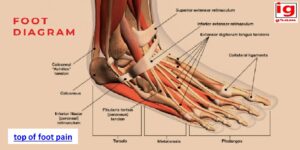
Signs You Can’t Afford to Miss.
Top of foot pain may vary between irritating and severe. Pay attention if you notice:
- Persistent swelling
- Pain lasting more than a week
- Pain that worsens with rest
- Redness or warmth
- Difficulty bearing weight
These symptoms can be a symptom of other more severe underlying problems.
Diagnosis of Top of foot pain.
A medical practitioner can use:
- Physical examination
- Activity and footwear history
- X-rays (for fractures or arthritis)
- MRI or ultrasound (for tendon or nerve issues)
Early diagnosis often shortens recovery time.
Effective Therapies Which Do Work.
At-Home Relief Options
In cases of mild to moderate top of foot pain this is a good place to begin:
- Rest: Alleviate behaviors that cause pain.
- Ice: 15–20 minutes, 2–3 times daily
- Footwear: do not use tight and inappropriate shoes.
- Unlace: This is particularly done over the top of the foot.
- Elevation: Assists in the elimination of swelling.
Targeted Treatments
Treatment may include depending upon the cause:
- Physical therapy in order to increase strength and flexibility.
- Anti-inflammatory drugs (prescription by a specialist)
- Orthotics or shoe inserts
- Stress fracture temporary walking boot.
- Cortisone Injection in acute inflammation.
The surgery is infrequent and only used in cases where the conservative treatment is not successful.
Real-Life Example
One of the retail workers also experienced pains on the top of her foot when she switched to stiff dress shoes. The pain worsened daily. Once her laces were loosened, she then switched to cushioned footwear, after a week she was completely better, without medication.
The cure truly is that easy sometimes.
Prevention of Top of foot pain.
It is usually difficult to recover than to prevent.
- Select shoes properly supporting and having to space.
- Avoid overtightening laces
- Raise the activity levels in a gradual manner.
- Exercise your feet and ankles.
- Replace worn-out shoes
Even minor modifications could have an enormous impact.
FAQs
- What is the most frequent provocation of a top of foot pain?
The most common cause is the extensor tendonitis which is mostly associated with tight shoes or overuse.
- Would top of foot pain resolve itself?
Yes, the mild cases tend to end with rest, ice and change of footwear. Constant pain should be assessed.
- Is top of foot pain serious?
Not necessarily, however, persistent pain, swelling or walking problems should be examined to eliminate stress fractures or nerve problems.
- When I walk, I feel pain in the top of my foot.
Walking strains the tendons and bones. Movement pain is usually a indication of tendon inflammation or bone-stress.
- Do the shoes produce pain in the top of the foot?
Absolutely. The major cause of this kind of pain is tight/stiff/poorly designed shoes.
- Is it better to exercise when the top of the foot is pained?
High impact activities should be avoided until the pain gets better. In some cases, low-impact can be safe and it depends on the severity.
Final Thoughts:
Toe pain is the signal of the body that needs attention. It can be a mere shoe problem or a bigger problem but leaving it without attending to it never helps. The sooner you react the quicker (and easier) to recover.
It is hardly likely that your foot would request miracles were it able to talk. Just a little care.
Also read- Best whoop 5 blood pressure tip


1 thought on “Best 5 top of foot pain cause”