
In this article, we shall deconstruct the What is inflation?, phenomenon of inflation, what causes it, how it is measured, how it affects our day to day lives.
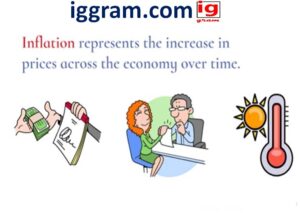
What is Inflation: The Fundamentals of Inflation.
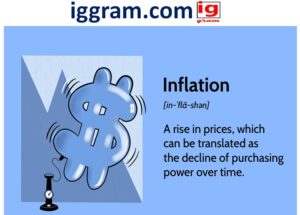
Inflation in its simplest form means general rise in prices of goods and services over time. When there is inflation, purchasing power of money is reduced and this implies that you can purchase less than before with the same amount of money.
To illustrate, when loaf of bread was two dollars last year and it is two dollars and twenty cents this year then the inflation rate is 10%. The value of money can be completely eroded even by small inflation levels over time.
There is usually a saying among economists that inflation is the silent tax since it meanders away the worth of savings and income without careful consideration.
Types of Inflation
Not all inflations occur due to the same reason and they may occur in many forms depending on the driver. The main types include:
- Demand-Pull Inflation
This takes place whereby the demand of goods and services is more than supply. Imagine it to be too much money and too little goods.
The consumers spend more money when the amount of money they have as disposable income increases and companies adjust the prices to meet demand. An illustration is the situation of demand-pull inflation experienced in the period of economic booms.
- Cost-Push Inflation
This occurs when the cost of production is high hence companies have to charge higher prices in order to sustain profits.
As an example, when the cost of crude oil increases, transportation and production costs also increase and push the prices of most goods.
- Endemic Inflation (Wage-Price Spiral).
The inflation in this scenario is a cyclical process where workers demand more wages to cope with the increasing cost of living, and companies, in their turn, have to increase the prices to cover increased labour costs. This makes a vicious cycle of itself.
- Hyperinflation
This is severe and infrequent type of inflation in which prices are increasing out of control- sometimes by hundred or thousand percent per year.
An example is in Zimbabwe in late 2000s when prices were doubled nearly every day. Hyperinflation normally causes the fall of an economy and a lack of trust in a currency of a country.
- Stagflation
A mixture of low economic growth, unemployment and inflation. This is especially hard to deal with due to the fact that the conventional measures of inflation control may aggravate the employment problem or reduce the growth rate.
How Inflation Is Measured
A number of most important indicators are used by economists to gauge inflation, though the most common ones are:
- Consumer Price Index (CPI)
The CPI measures the fluctuations in the average price level of a basket of goods and services that are usually sold such as food, housing, transportation, health care and entertainment.
When the CPI increases by 3 per cent in a given year then it implies that the average cost of living has also gone up by 3 per cent.
- Wholesale Price Index (WPI)
WPI is a measure of price changes at wholesale or producer level, prior to the goods being received by consumers. It is usually a foreteller of inflationary tendencies.
- Producer Price Index (PPI)
Just like WPI, the PPI examines the movement of prices in view of the producers. It assists in predicting the future consumer price volatility.
- GDP Deflator
The GDP Deflator is used to determine inflationary levels throughout the economy as compared to the prices of goods and services in a defined base year. It represents consumer and business expenditure.
Causes of Inflation
Inflation may be caused by a variety of causes such as:
- Monetary Causes
As money supply within a given economy rises at a greater rate than production, there is excess money in search of limited goods. This usually occurs when the central banks maintain low interest rates or emit more money.
- Demand Factors
Consumer confidence and large consumer spending could drive the demand beyond supply leading to an upsurge in prices.
- Supply Chain Issues
Supply-related disruptions may cause changes in the cost of production due to shortages of raw materials, energy, or transportation jams hence inflation.
- Global Factors
Wars, pandemics, or geopolitical conflicts may lead to world shortages or trade bans, which will raise the price on the global arena. As an example, the COVID-19 pandemic resulted in supply chain issues, which caused inflation in most countries.
The Effects of Inflation
Inflation affects the whole population of consumers, businesses and governments. Let’s explore how:
- On Consumers
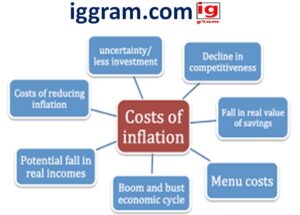
The immediate impact is the loss of buying power. Your funds are less to purchase and living expenses become high.
An example is that when there is 5 per cent inflation and your income increases by 3 per cent, then in actual sense, your real income will be reduced.
- On Savings
The savings values are diminished by inflation. Your savings will lose value over the years unless they are interest earning at a higher rate than the inflation rate. That is why lots of individuals invest into such assets as stocks, real estate or bonds that are indexed to inflation.
- On Borrowers and Lenders
This is the advantage that inflation brings to the borrowers as the borrowed money is repaid at a low price compared to the time they took it. But lenders suffer because of the same reason.
- On Businesses
The firms have increased expenses of raw materials and salaries. Some can be able to transfer these costs to the consumers, but others might not be able to do so and this will lower the profit levels.
- On the Economy
The middle range inflation promotes spending and investments because individuals will not have many cash hoards. However, at a very high level of inflation, it brings about uncertainty, it discourages investment and may even slow down economic growth.
Conclusion
Inflation is an intrinsic element of any economy – it is growth, demand and change. But once it increases too quickly it may become a burden to the household, mess up business planning, and pose a challenge to governments.
It is important to know what is inflation and why it occurs, and the impact of inflation on you, to make wise financial choices. Remaining updated and changing your spending and investment behavior can help you remain safe of the insidious effect of inflation, and can help your money retain its real worth as the years go on.
Also read- Trump announces extra 100% tariff on China imports


1 thought on “Exposed in simple 3 step What is inflation?”