
Learn all about the baby monkeys, their habits, development, food and fun things. The ultimate source of wildlife information, including FAQs.
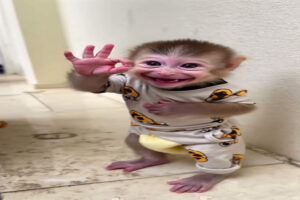
Baby Monkey: Nurture, Development, Care, and Interested Facts about Baby apes.
People all over the world always have a soft spot in their hearts towards baby monkeys. Their good nature, gladiator intellect, and their expressive eyes make them one of the most interesting of the youth among animals in the wild. Curious to know how baby monkeys grow, what they eat, how they behave, why they are so much emotionally attached to their mother, this is the complete guide to everything you want to know.
Here we are going to discuss the behavior of baby monkeys, their stages of development, peculiarities, species differences, and the way they manage to survive in the nature.
What Is a Baby Monkey Called?
The young monkey is generally referred to as an infant, just like other human babies. This is an indication of the fact that monkeys are very similar to human beings during their early stages of development. They are also casually referred to by some people as little monkeys or monkey babies although the scientific name has always been infant.
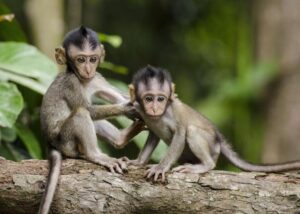
How Baby Monkeys Are Born?
Depending on the species, baby monkeys are born in 134-240 days. All the other wild animals do not have their eyes open and strong gripping reflexes, unlike monkey infants who are usually born with their eyes open, and with strong gripping reflexes. This assists them to hold their mother immediately after birth.
Mother clinging Baby monkeys remain in physical contact with their mothers all the time, even in weeks or months, a behavior that is essential to emotional attachment and survival.
Stages of Behavior and Development of Baby Monkeys.
Knowledge on the behavior of baby monkeys can provide us with information about primate intelligence and social development. Their development might be split into several major phases:
- Newborn Stage (0–2 months)
- Entirely at the mercy of their mother.
- Hug in her back or stomach to get warm and safe.
- Drink only mother’s milk
- Communicate using low-key voice and cries.
- Exploring Stage (2–6 months)
- Enhance environmental exploration.
- Be interested in other members of the troop.
- Start learning social cues
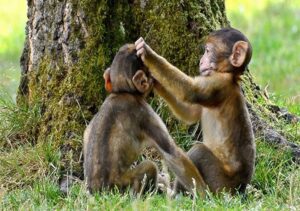
- Such imitative actions as grooming or climbing.
- Playful Juvenile Stage (6 months–2 years)
- Very active, jovial, and outgoing.
- Play-fighting, playing chaser, climber.
- Get survival skills through imitating adults.
- Begin to eat solid food though keep on breastfeeding.
The baby monkeys also learn through imitation, something which is common in human beings. They observe adults in order to know how to get food, be aware of danger, communicate, groom, and socialize.
What Do Baby Monkeys Eat?
A baby monkey depends on age and species although mostly it includes the following:
Primary food sources:
- Mother’s milk (first several months)
- Soft fruits
- Leaves and flowers
- Insects (for protein)
When the monkeys are old enough they are taught how to forage by themselves. Tropical monkeys such as spider monkeys love fruit whereas the macaques have a more diverse diet that can comprise of seeds, roots, and small animals.
Why Baby Monkeys Like Attaching with their Mothers?
Babies monkeys develop a strong emotional attachment with their mother. This is because:
- They are dependent on the mother.
- Contact with the skin decreases stress hormones.
- The way social learning occurs is by observation.
- Mothers also impart rules of social interaction and communication.
- Hugging keeps them away out of harm.
It has been found out that early destruction of this bond leads to behavioral problems in life long just like early separation in humans.
The Various Babies in the Monkey Society.
Monkeys have more than 260 species and infant monkeys are greatly different based on the species. The following are some of the notorious instances:
Baby Capuchin Monkey
- Extremely intelligent
- Known for curiosity and tool use
- Very social and active
Baby Spider Monkey
- Born with long limbs
- Excellent climbers
- Depend heavily on mothers
Baby Macaque
- Common in Asia
- Easygoing and emotional.
- Build good relations with troops.
Baby Howler Monkey
- Identified by their beat which calls.
- Slow-moving and calm
- Infants are very attached to the back of the mother.
Baby Marmoset
- One of the smallest primates
- Often born as twins
- Extremely rude and quick learners.
How Baby Monkeys Light Survive in the Wild?
Baby monkeys have to endure a lot but they can withstand all difficulties because of the instincts and protection of their troop. The important survival factors are:
- Clinging Ability
Their grip reflex is powerful since birth thus they are able to cling on to their mother when travelling.
- Social Protection
Such monkey troops cooperate to ensure that infants are free of danger of predators such as eagles, big cats, and snakes.
- Early Learning
Young monkeys learn to be aware of danger very quickly, e.g., alarm calls.
- Play Behavior
Play is a way of learning coordination, balance, and problem solving which are vital in survival.
Interesting facts regarding baby monkeys.
The following are some of the shocking and easy to find facts:
- Monkey babies are able to identify faces in the first few days.
- The purpose of grooming is very significant in the formation of relationships.
- There are those monkeys that share parenting and there are those that are dependent on the mother only.
- Baby monkeys laugh in the course of play just like human babies.
- Their brains develop at a high rate within the initial year, which forms intelligence and memory.
Baby Monkey Emotional Intelligence
Scientists established that infant monkeys exhibit higher emotional skills:
- They decipher facial expressions.
- They form friendships
- They exhibit empathy
- They are capable of being jealous or being afraid.
This renders them to be amongst the most emotionally multifaceted little creatures.
FAQs:
- What is the length of time that baby monkeys remain with their mothers?
The duration of stay with the mother of a baby monkey varies with the species and ranges between 1 and 3 years.
- What do baby monkeys eat?
They mostly feed on milk but they slowly begin feeding on fruits, leaves and seeds and insects.
- Are baby monkeys good pets?
No. Baby monkeys require complicated social settings and in-service. They cannot be owned in several areas.
- How smart are baby monkeys?
They are very bright, as they are able to learn by observation, problem solving and emotional communication.
- Do baby monkeys cry?
Yes, they issue low cries and calls to say they are hungry, uncomfortable or to say good-bye.
- What kills baby monkeys out in the wild?
Eagles, big cats, snakes and the rival troops are common predators.
- Of potential interest: will baby monkeys be able to walk when they are born?
Not exactly. Although they are capable of cling, and make some movement, it is not until months are passed before they have the complete freedom of motion.
Conclusion
Baby monkeys are one of the most interesting and fascinating species in the animal world because they provide one of the few perspectives on the intelligence, feelings, and sociology of primates. Since they highly rely on their mothers at the early age, their behavior towards the playful juvenile life is more or less the same as that of humans. Not only does the concept of the growth, the way baby monkeys learn, and survive, further increase our appreciation of the wildlife, it also shows the need to protect their natural environments.
With the ever-growing threats of deforestation and illegal trade in wildlife taking its toll on most of the primates, it is important to disseminate awareness. When we get to know about baby monkeys, their interactions, eating habits, struggles, and amazing emotional attachments, we are making a worthwhile contribution to conservation efforts and making sure that other generations to come will not only be able to marvel at these amazing young primates but also see them in nature. You will find reading more about the primates to be a highly fulfilling and informative experience in case you are intrigued by their beauty, intellect and social environment.
Also read- Best 7 beanie baby birthdays


2 thoughts on “Best 5 Baby monkey”