
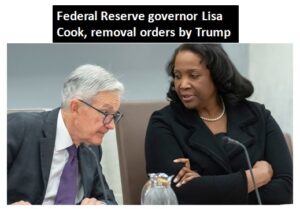
over mortgage fraud allegations Federal Reserve governor Lisa Cook, removal orders by Trump wrote in his letter to Ms. Cook: “I have determined that there is sufficient cause to remove you from your position”.
What’s Happening Now
- President Trump has announced he is firing Lisa Cook, citing allegations of mortgage fraud—claiming she misrepresented her primary residence to obtain favorable mortgage terms. This comes via a public statement on August 25–26, 2025. This move marks the first-ever attempt by a U.S. president to fire a sitting Fed governor
- Cook rejects the firing as unlawful. She asserts that the president lacks the legal authority to remove her—Fed governors serve 14-year terms expressly designed to protect the Fed’s independence and can only be removed “for cause.” She says she will not resign and will remain in her post while mounting a legal defense
- A significant legal showdown looms. Cook has secured prominent attorney Abbe Lowell. Experts suggest this unprecedented move may provoke a constitutional and statutory court battle over the boundaries of presidential power and the political independence of the Federal Reserve
- Political leaders are reacting strongly, with many Democrats calling the attempt an authoritarian overreach that endangers central bank independence and could undermine financial stability and investor confidence

Who Is Lisa Cook?
- Trailblazing economist: Lisa DeNell Cook is the first Black woman to serve on the Federal Reserve’s Board of Governors, appointed by President Biden in 2022 with her term slated to run until 2038. Her confirmation was historic—and narrowly won via a tie-breaking vote by then–Vice President Kamala Harris
- Academic & policy background: Cook holds a BA from Spelman College, studied PPE at Oxford as a Marshall Scholar, and earned a PhD in Economics from UC Berkeley. She taught at Michigan State University and Harvard, held roles in the Clinton, George W. Bush, and Obama administrations, and has directed programs promoting underrepresented minorities in economics
- Recent remarks: Just weeks before this controversy, Cook voiced concern over sluggish July unemployment figures and cautioned that significant revisions in the data often signal economic turning points.
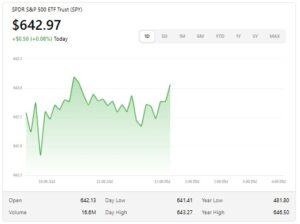
Here’s the latest snapshot of the U.S. stock market, reflected through the SPDR S&P 500 ETF (SPY):
Three main reason of Federal Reserve governor Lisa Cook, removal orders by Trump-
- Lawful Precedents on Fed Governor Removals
- The Federal Reserve Act of 1913 states that governors may be removed only “for cause”, though the law doesn’t clarify what constitutes adequate cause—usually interpreted as misconduct, neglect of duty, or malfeasance
- Historically, no U.S. president has ever removed a Fed governor. When President Trump announced he was firing Lisa Cook, it marked an unprecedented move in Federal Reserve history
- Several Supreme Court rulings inform the debate over removal power:
- Myers v. United States (1926) held that the president has the exclusive power to remove purely executive officers (broad removal authority)
- Humphrey’s Executor v. United States (1935) created an exception, allowing for-cause removal protections for independent, quasi-legislative or quasi-judicial agencies like the FTC
- More recently, Seila Law (2020) and Collins v. Yellen (2021) went much further to expand presidential removal authority by enjoining some of the statutory limitations but did not grant the Fed governors directly, and the Fed per se status will accordingly continue to differ with the rest of U.S. governmental employment.
- Legal scholars debate whether Congress can maintain the Fed’s independence given its blend of policy-making and sovereign regulatory functions. Some argue recent Court precedents undermine for-cause protection, while others believe Congress must restructure the Fed to clearly separate “executive” functions if it wants to preserve autonomy
In summary:
No legal precedent supports removal of a Fed governor without due process. The phrase “for cause” remains undefined in this context, and the courts have never tested it. The response by Trump therefore spawns one of the biggest constitutional challenges to independence and presidential prerogative.
- Lisa Cook Biographical Breakdown:
Historic firsts: Lisa DeNell Cook is the first Black woman to serve on the Federal Reserve’s Board of Governors. Her 14-year term, starting in 2022, extends through 2038
- Academic and policy pedigree: She holds a BA from Spelman College, studied PPE at Oxford University as a Marshall Scholar, and earned her Ph.D. in Economics from UC Berkeley. Her career is varied and traverses academia (Michigan State, Harvard), and public service under several administrations (Clinton, George W. Bush, and Obama), including work to diversify the field of economics
- Instant response to firing: Cook has denied categorically of her involvement in the charges related to the issue of mortgage fraud and asserts that Trump has no lawful grounds to end her without any cause and without the proper procedure.She has refused to resign and secured legal counsel to fight the move
- Market Response—Current Signals
- Following the announcement of Cook’s dismissal, stock futures dropped slightly and the U.S. dollar weakened—a sign that markets are unsettled by political interference in central bank independence
- Economists comment that credibility and independence are core to preserving investor confidence and anchored inflation expectations and indeed these are what the Fed is based on. Any perceived erosion of that independence could lead to destabilization—higher borrowing costs, volatility, and unpredictable monetary policy
- Although SPY, which tracks the S&P 500, shows only minor intraday fluctuations now, the situation remains fluid. Investors are expected to be widely following legal affairs, as it may bring changes to the markets and stability of policies.
Summary:
Lisa Cook’s firing attempt is without precedent, putting presidential power against Fed independence. Her life story highlights she was a pathbreaker and an academic superwoman making it more competitive. Markets so far are holding steady, but risks of instability loom if the legal battle drags out.

