

The first human case of New World screwworm, a flesh-eating parasitic fly confirmed in U.S., says by authorities. The case was confirmed on 4 August 2025, marking the first U.S. human infection in years.
What Just Happened?
- A human case of New World screwworm, a flesh-eating parasitic fly (Cochliomyia hominivorax), was confirmed in Maryland, marking the first U.S. human infection in years.
- The patient had recently traveled to El Salvador—though some industry sources suggested Guatemala. The Centers for Disease Control and Prevention (CDC) confirmed the case on August 4, 2025, but the travel origin remains officially El Salvador.
- The good news: the individual has recovered, and no further transmission to other people or animals has been reported. Authorities have reassured the low level of the risk to the health of people.
Why It Matters
Screwworm History & Biology
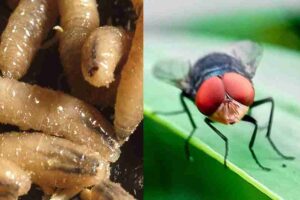
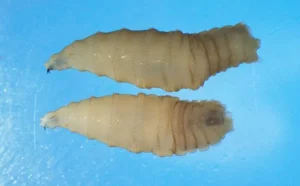
- Screwworms lay eggs in wounds of warm-blooded animals, and larvae feed on living tissue—earning their “flesh-eating” nickname. Though rare in humans, infestations can be fatal if not treated early.
- The U.S. eradicated screwworm in the 1960s using the sterile insect technique—releasing sterilized male flies to disrupt reproduction.
Current Threat & Response
- Screwworms have been advancing north from Central America and Mexico since 2023. The U.S. and Mexico are ramping up defensive measures to stop their spread.
- The USDA plans to build a sterile fly production facility at Moore Air Force Base in Texas, expected to produce hundreds of millions of sterilized flies per week. A similar facility is planned in Mexico.
- Economic stakes are high. A potential outbreak in Texas alone could mean $1.8 billion in losses due to livestock mortality, labor, and medication costs.
What Are Screwworms?
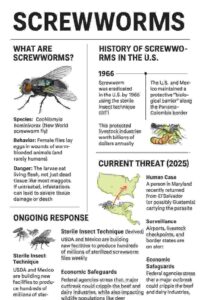
- Species: Cochliomyia hominivorax (New World screwworm fly).
- Behavior: Female flies lay eggs in wounds of warm-blooded animals (and rarely humans).
- Danger: The larvae eat living flesh, not just dead tissue like most maggots. If untreated, infestations can lead to severe tissue damage or death.

History of Screwworms in the U.S.
- Screwworm was eradicated in the U.S. by 1966 using the sterile insect technique (SIT).
- The U.S. and Mexico maintained a protective “biological barrier” along the Panama-Colombia border by continuously releasing sterile male flies.
- This protected livestock industries worth billions of dollars annually.
Current Threat (2025)
- Human Case: A person in Maryland recently returned from El Salvador (or possibly Guatemala) carrying the parasite. They have since recovered.
- Livestock Risk: If screwworm spreads into Texas and beyond, cattle, deer, and pets would be at risk. Losses could exceed $1.8 billion in Texas alone.
- Geographic Distribution: Screwworm populations have been invading up through Central America since 2023 causing concern in Mexico and the US.

Ongoing Response
- Sterile Insect Technique (revived)
- USDA and Mexico are building new facilities to produce hundreds of millions of sterilized screwworm flies weekly.
- One major plant is being established at Moore Air Force Base, Texas.
- Surveillance
- Airports, livestock checkpoints, and border states are on alert.
- Hunters and farmers are being told to watch for unusual wounds in animals.
- Economic Safeguards
Federal agencies warn a major outbreak could devastate the beef and dairy industries and also harm wildlife populations such as deer
Economic Risks for Cattle
- Direct Losses: Screwworm infestations can kill cattle outright, or force ranchers into expensive veterinary care.
- Productivity Decline: Infected animals lose weight, suffer poor milk production, and have reduced breeding potential.
- Estimated Cost: USDA analysis indicates that an outbreak of screwworm in Texas alone could cost more than $1.8 billion a year in terms of lost life, labor, and treatment (mortality).
Market Impacts
- Beef Prices
- If screwworm spreads into U.S. herds, ranchers could lose cattle. Reduced supply = higher beef prices.
- Steers would have to be paid more to be fed in feedlots and slaughtered by packers thus raising the expenses passed on to customers.
- Export Concerns
- Trading partners would consider imposing bans on U.S. beef export in order to inhibit the transmission of parasites.
- Even rumors of screwworm infestations could shake international confidence.
- Insurance & Rancher Costs
- Ranchers would face higher costs for surveillance, veterinary checks, and insect-control measures.
- Livestock insurance rates could spike, especially in border states like Texas, New Mexico, and Arizona.
- Market Volatility
- Just the confirmation of a human case already caused jitters in agricultural markets.
- Futures markets (live cattle contracts in Chicago) could see price swings based on screwworm containment reports.

Outlook
- Short Term: Minimal disruption—risk contained so far, cattle markets largely stable.
- Medium Term: If screwworm enters U.S. herds, markets could see supply shocks and consumer price inflation for beef.
- Long Term: Ongoing USDA–Mexico sterile fly program will be critical to reassure markets and protect billions in U.S. cattle value.
Bottom Line
The appearance of a confirmed instance of the screwworm parasite in a human- linked to visits to Central America-has caused a new sense of urgency. Public risk is minimal at present but agricultural and livestock producers are high alert in the wake of the devastating capacity of screwworm. The multi-pronged approach that the U.S. government undertakes to fortify livestock and ensure that it does not regain strength is in full swing involving revival of the historic mass sterilization methods.
The single human case in Maryland doesn’t pose a public health emergency, but it’s a red flag. Authorities are treating it as a wake-up call: the parasite could re-establish in U.S. soil if surveillance and eradication programs don’t stay ahead of its spread.
In other words: cattle traders and ranchers aren’t panicking yet, but screwworm’s return would be as much an economic crisis as a biological one.
also visit home page-https://iggram.com/