
use of Tylenol is risk of autism Will the Trump administration proven in 2025 ? Research indicates a conflicting outcome of the use of Tylenol in pregnancy and autism risk, however, the best research shows no established correlation; the researchers are still convinced that acetaminophen is safe.

What the reports are saying
- The Trump administration, through Health Secretary Robert F. Kennedy Jr., will also propose formally that acetaminophen (the active ingredient in Tylenol), when administered during pregnancy, could be associated with an increased risk of developing autism in kids.
- The advice will also allegedly recommend that pregnant women should only use acetaminophen to treat high fevers (or other more serious infections), and not to treat those more commonly used to treat pain/pain relief.
- Also anticipated: the administration will also mention leucovorin (a folate / vitamin B9 derivative) as a possible treatment of part of the autism symptoms.
What is in doubt / debatable
- The evidence of the relation of acetaminophen in pregnancy to autism is weak, mixed, or inconclusive. Small associations are found in some of the studies, but not in others, including large and well-designed studies.
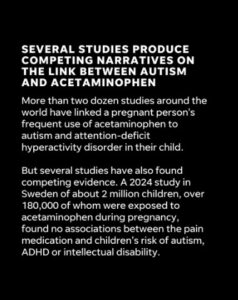
- Specifically, a Swedish study of approximately 2.5 million births did not observe any autism, ADHD, or intellectual disability increase in children who compared siblings whose mother used acetaminophen at one of her pregnancies. That avoids the biting of the bullet.
- Experts emphasize that there exist numerous confounding factors (i.e. the causes of the acetaminophen usage – infections, fevers or inflammation may also be risk factors by themselves). In addition, such factors as genetics, maternal health, environment, etc., are known to play a role.

What experts are saying
- Medical organizations such as the American College of Obstetricians and Gynecologists are holding on to the opinion that acetaminophen is safe in pregnancy provided that it is taken in moderation, as recommended.
- E.g. the drugmakers (manufacturer of Tylenol, Kenvue) firmly deny any causal relationship, claiming that according to independent and good science, the intake of acetaminophen is not responsible to autism.
- The international analysts are cautious not to read too much in the associations. It is said that the evidence is too small to warrant big shifts in instructions.
My take & what to watch
- It would be scientifically proper to do it as a hypothesis under test, and not as a proven fact.
- In the event that the announcement occurs, it might have an impact on the recommendations to pregnant individuals, such as more restrictions on the use of acetaminophen, more warnings, or a request to conduct more research.
- Noteworthy: When the acetaminophen is stopped whenever it is necessary (e.g. in case of fever), it may be dangerous as well (a pregnant woman has a fever which has its own adverse effects). Messaging will therefore be important.
The most significant researches & reviews (what they report)
1.The extremely large sibling-control design in the JAMA (Sweden, approximately 2.5 million births) – the major point: even with the sibling comparisons (which are considered to control the effect of many shared family/genetic factors), the risk of developing autism, ADHD, or intellectual disability after prenatal acetaminophen exposure was no longer increased. Due to familial confounding, authors conclude that earlier associations can be because of familial confounding. This is among the most powerful unilateral evidence to the absence of a causal effect.
2.BMC Environmental Health review (2025) is an unstructured literature review/synthesis article — major finding: a current analysis of the epidemiology reveals diverse studies that report associations, but there is heterogeneity in findings because the review notes that the methodology could be limited; the review cautions against generalizing. It records numerous cohort studies experience small risk increments but that quality of evidence is ill-defined.
3.Six European cohorts (Alemany et al.) in meta-analysis – noteworthy fact: pooled cohort data demonstrate the relationship between prenatal acetaminophen exposure and neurodevelopmental problems (e.g. ASD-like symptoms or ADHD symptoms), but these are only correlations, and depend on timing of exposure and measures. Results of meta-analysis are prone to differences in study design.
4.The earlier and more recent cohort studies (different centers: Harvard, Mount Sinai, etc.) – the most important point: some of the individual cohort studies (and press releases made by academic centers) report modest associations, especially when exposure is measured by maternal report and/or is linked to longer/higher-dose use; a number of studies mention that the increased risk might be due, or in part due, to infection/fever, and not the drug itself.
5.Authoritative expert summaries and science press – such sources as scientific American, science media centre, and government health experts all stress that the evidence was inconclusive and that acetaminophen should still be used when needed (lowest dose, shortest duration) because untreated fever is also damaging. They observe the sibling-control findings as of particular significance.

Reasons why the literature is mixed -methodological issues to be aware of.
- Confusion by indication: Women are taking acetaminophen because of pain, fever or infection. The presence of fever/infection during pregnancy in itself is a plausible predictor of neurodevelopmental outcomes, and therefore the drug could be an indicator of an underlying risk, but not necessarily the cause. Sibling designs assist with this although not eliminate all the confounding.
- Measurement issues with exposure: Most researchers use maternal self-report (those are recall biased) or prescriptions (no OTC). Imperfect measurements of dose, timing (trimester), frequency/duration, and precise timing are all common.
- Uncontrolled confounding and genetics: The patterns of health of families with increased genetic risk of neurodevelopmental disorders may be different (e.g., parents with NDDs may take medications in different ways). Other studies conclude that parental neurodevelopmental history predicts use of acetaminophen making it difficult to make claims about causes.
- Sibling-control strengths & limits: The strength of sibling comparisons (same mother different pregnancies) holds all shared factors of the family together, and usually the association is non-significant – that would be a strong argument against having any cause effect. But sibling designs are also vulnerable to erosion and they can be biased in cases such as exposure being not equal within a family because of other reasons, also outcome-related. Nevertheless, they are the most informative observational designs in this case. Heterogeneity of studies: The inhomogeneity of the results links the apples and oranges because of differences in population, definition of exposure, outcome measurement (clinical diagnosis vs. symptom scales) and statistical adjustments.
Evidence-based practical implications/guidelines.
In pregnancy, the existing major clinical recommendations still recommend the first-line analgesic/antipyretic use of acetaminophen when needed (the lowest concentration to be used should be used as shortly as possible). Professionals caution against the untreated fevers during pregnancy.
- The announcements of the policy must be precautious: Since the evidence is mixed, and untreated fever may even harm, the majority of scientists should conduct more research and communicate it better instead of banning it. The results of sibling-control undermine the strong claims of causation.
- Research priorities: improved exposure (dose/timing), mechanisms research (animal and biochemical research), and random or quasi experimental designs where feasible ethically / potentially possible; long -term follow-up with important confounders controlled.
Conclusion:
Scientific data on the cause and effect of prenatal acetaminophen (Tylenol) is not yet confirmed. Whereas some observational studies give weak correlations, large high-quality studies, particularly sibling-control studies, do not report an increased risk after the effects of familial and medical confounders have been adjusted. In the case of taking minimal effective dose of acetaminophen over the shortest time, medical organizations still prescribe it as the safest over-the-counter analgesic and fever medication during pregnancy. Further study will be required, but the burden of existing data is not in favor of sweeping policy changes.
Also read- Trump Introducing a $100K annual fee on H-1B visas


2 thoughts on “use of Tylenol is risk of autism Will the Trump administration proven in 2025 ?”