The truth about anti-corruption protest in nepal 2025, rallies as Gen Z protesters demand changes to a social media ban that has been lifted. An investigation panel is new, the number of the dead 19, and the world condemnation, all point to the difficulties in the functioning of governance and corruption.
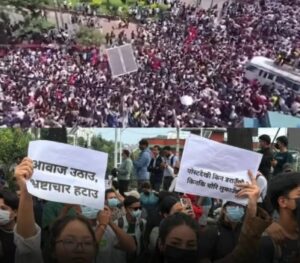
What concerns the anti-corruption protests going on in Nepal today, on September 9, 2025:
What’s Going On?
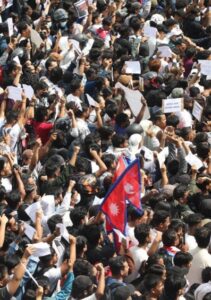
- Massive Gen Z–led Protests
The protests came to be known as the Gen Z protests which were mainly organized by the younger generations in Nepal and were also triggered by both rampant corruption and a blanket ban imposed on 26 large unregistered social media sites including Facebook, Instagram, Whatsapp, YouTube, and X among others.
- Bloody Faceoffs and Deaths.
On September 8, 2025, a police fired on protestors outside the Parliament building, Kathmandu. At least 17 deaths and approximately 145 injuries were reported in the confrontation including wounded police officers. Other accounts put the number at 19 killed and more than 200 injured.
- Government Responding: Curfew and Ban Reverse.
To curb the violence, a state of indefinite curfew was declared in Kathmandu, a temporary one in neighboring Lalitpur. As of September 9, the government had withdrawn the social media block, and access to sites such as Facebook was restored according to Cabinet Minister Prithvi Subba Gurung.
- Aftermath and Investigations
On the fifth day, the company must conduct an investigation into the root cause of the accident and provide details regarding the investigation procedures. On day five, the company is to make an investigation into the origin of the accident and give information about how the investigation will be done.
Prime minister K.P. Sharma Oli lamented the loss of life and said that he would compensate the families of the victims, offer free medical care to the injured, and establish a fifteen day investigation panel to probe the events. Ramesh Lekhak resigned as a home minister following the outrage of the masses.
- Demonstrations on the streets do not stop with the social media.
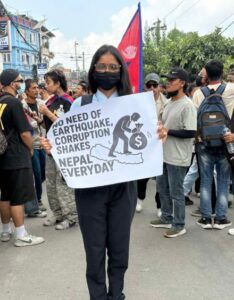
The demonstrations, in spite of the ban being lifted, have continued. Opponents are making more dramatic demands of government transparency, economic freedom, and expanded democracy, with such slogans as “Stop corruption, not social media.
Insights & Notes
- The demonstrations are not simply a response to censorship, but a wider manifestation of a younger generation that is angry about a failure in the existing order.
- Probably the most striking observation is that the social media ban was reversed at an unusually high pace by the government apparently due to the growing unrest, rather than policy reevaluation.
- Whether the proclaimed 15-day investigation will result in any material reform is yet to be observed.
About the continuing demonstrations in Nepal:
- Places of demonstrations that are still going on.
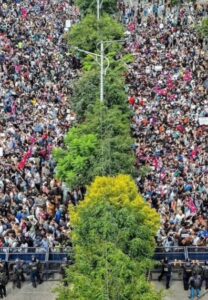
- Its epicentre is Kathmandu, especially in the areas of Maitighar Mandala, New Baneshwar and the premises of the Parliament. The demonstrators in this area have gone beyond the barricades triggering intense response on the side of the police that has been characterized by water cannon, tear gas and live ammunition.
- Protests have also extended to other big cities like Pokhara, Butwal and Dang, and young people have launched demonstrations that show their national discontent.
- There is a government declared curfew in Kathmandu and it targeting New Baneshwar region and its environment, but despite the restrictions, unrest prevails.
- International Reactions
- UN Human Rights Office, via spokesperson Ravina Shamdasani, denounced the murders and demanded a transparent and quick investigation into the murder.
- Amnesty International also came in to denounce the crack down and demanded independent inquiries and accountability.
- Indian Ministry of External Affairs was very worried and showed condolences. It observed that it is closely following the progress as it advises Indian nationals in Nepal to follow precautionary and curfew instructions.
- The Committee to Protect Journalists (CPJ) condemned the ban saying that it is a dangerous precedent in censorship and affects press freedom and revelation.
- The Nepal National Human rights Commission (NHRC) also issued warnings that the media blockage would hamper constitutional rights and the government should implement other forms of control.
- The Federation of Nepali Journalists (FNJ) and the other civil society organizations strongly protested against the ban as being unconstitutional and a breach of democratic free expression.
- Investigation Panel: Composition & Purpose.
- The government has declared the establishment of a 15-day investigation committee to find the underlying causes, damage evaluation, and recommend preventive measures.
- Although the individual names or party representation of this new panel are yet to be announced, it is independent of the previous parliamentary investigation efforts- such as the seven-member committee that is catapulting the controversy over the cooling-off period, which consists of representatives of the Nepali Congress, CPN-UML, Maoist Centre, Rastriya Swatantra Party, and Rastriya Prajatantra Party.
- As information unfolds, we can be on the lookout of information on panel composition, clarity of mandate and transparency provisions.
- Counter-Corruption Background: Legislation and Practice.
Legislative Framework:
- The Nepal anti-corruption law is the Prevention of Corruption Act, 2002 (2059 BS), which outlines a wide scope of corrupt offenses and provides punitive mechanisms.
- In 1991, the CIAA Act established the Commission of Investigation of the Abuse of Authority (CIAA)- the constitutional body that is required to investigate and prosecute corruption. It consists of one overall commissioner and a number of regional commissioners.
Recent Reforms:
- In April 2025, the Anti-Corruption Act was amended to enhance accountability- penalizing not only abuse of power but also the wilful refusal or the deliberate delay by a public servant. The penalty can be imprisonment (up to one year), fines, compensation tied to property, suspension of proceedings, use of more effective investigative methods (undercover work, electronic monitoring, admissible audiovisual evidence, etc.).
Challenges on the Ground:
- The CIAA is limited in resources, there is procedural slowing down, political influence and a limited jurisdiction particularly in the private sector which is a burden to its effectiveness despite its comprehensive laws.
Summary
The country is in a significant crisis, with anti-corruption and provocative anti-social media protest led by youths in Nepal, the so-called Gen Z is spreading all over the country. Demonstrations, with Kathmandu as the epicentre and extending to places such as Pokhara, Dang and Butwal, have been fatal and at least 19 people have been killed and hundreds injured as a result of police firing.
An unrest is still experienced despite the lifting of the ban, and there are still demands of accountability and democratic changes. The violence and censorship have been denounced by international organizations such as the UN, Amnesty and India.
A 15-day investigation panel has been established by the government and the anti-corruption system in Nepal, with the CIAA as a core, and the Prevention of Corruption Act as a foundation, is challenged by a lack of enforcement and politicization.
Also read- Shocking , Trump issued threats of war targeting American cities


2 thoughts on “The truth about anti-corruption protest in nepal 2025”