
Tariff on China imports, Trump has provisionally declared a 130% tariff on products manufactured in China. The current news has it that he has suggested or threatened to impose new 100 % additional tariff on Chinese imports (on top of current tariffs) beginning November 1.
What are the good sources that support them?
- The additional 100 percent tariff on imported goods of Chinese origin that Trump will introduce starting November 1 (or earlier) on top of the existing tariffs.
- He also declared export controls on any and all critical software as a retaliation package.
- It has been commented that, under existing tariffs, cumulative damage to Chinese goods might be as much as 130 percent, in some categories.
The reason why 130 per cent tariff is probably a misstatement or overstatement.
- The amount of 130 percent is an appearance of numbers, probably of summing several layers of tariffs. As an illustration, a good already subject to say, 30 per cent duty on it, then a 100 per cent surcharge would take the overall tariffs to 130 per cent (i.e. original price + 30 per cent + 100 per cent). It does not necessarily imply that an announcement of a single tariff of 130 percent was made.
- No major news outlets use “130 percent” as the announced rate; they consistently report 100 percent
- It also means that such policies can sometimes attract legal, administrative or diplomatic backlash and the rate (or even the scope) that ends up being implemented may not be the same as the threat or offer.
What is known
- On October 10, 2025, Trump announced in Truth Social that he would like to apply an extra 100 percent tariff on Chinese imports beginning November 1 (or earlier, based on any action taken by China).
- According to media reports, this new 100% surcharge would be on top of any tariff they are already paying, or the overall duty burden on most goods would be close to or even more than 130%.
- The U.S. has already directed several waves of duties on China in 2025 under the jurisdiction of authorities such as IEEPA and Section 301.
- In April 2025, Trump raised reciprocal tariffs on Chinese products to 125 percent, over and above other rates, through his broad-based tariff package.
Legal and practical caveats
- Important announcements in the social media or through the statement of the president do not necessarily become law. An effective new tariff would have to undergo the legal and administrative procedures, such as in the case of rulemaking, notices, and implementation by U.S. customs and border protection.
- Some of the previous tariff activities by Trump have been challenged in the courts. As an example, critics and courts have asked whether he had overstepped the authority of IEEPA when imposing the blanket tariffs.
- At this point, I could not locate any official regulation, statute or executive order which applies a 130 percent tariff as a stand-alone rate. The number of 130% appears to be a combination of the 100% proposed surcharge and current duties charged on some of the goods.
- The stated 100 percent tariff is the action plan which is being monitored in both official and media sources.
Effects on the Imports and U.S. Businesses.
- Increased prices to importers: American firms that depend on Chinese products (electronics, machinery, furniture, and auto parts) would be affected at once by increased prices.
- Supply chain breakages: Not all firms would succeed in shifting to Vietnam, India or Mexico: Supply chains can take months or even years to re-align.
- Small business strain: Smaller retailers and manufacturers may experience intense cost pressures, in particular, the ones that lack alternative suppliers.
Consumer Price Effects
- Higher prices to the consumers in America: Electronics, clothing, household goods and car parts might become 10-20 percent pricier on average.
- Inflation risk: Analysts caution those another shock of tariffs might increase the general inflation by 0.3-0.5 percent, depending on the scope of application of tariffs.
- Potential sluggishness in consumption: In case of price increase, consumer spending, which is a significant factor in the U.S. GDP, may decrease.
Impact on China
- Short-term export hit: Chinese exporters would lose billions due to decreasing number of U.S. orders or going to other nations.
- Strategic retaliation: China could retaliate using its own tariffs, or banned access by U.S. businesses, or a cap on the export of essential materials (such as rare earths or batteries).
- Long-term diversification: China will gravitate towards engaging other leading markets like the EU, Southeast Asia, and Africa.
US Economic and Political Implications.
- Increased manufacturing (short term): There is increased competition in steel, aluminum, and autos and some domestic manufacturers might be able to benefit.
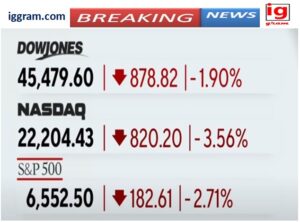
- Stock market volatility: Fear of trade wars usually leads to market sell-offs, and uncertainty on the part of the investors.
- Political politics: The move is popular with voters who are worried about the loss of jobs and trade shortfalls, but economists fear it might escalate living expenses ahead of the 2026 midterms.
conclusion
- Fact: Donald Trump declared another 100 per cent tariff on the imports of China that will be introduced November 1, 2025, or earlier.
- Clarification: This 130 per cent is not an official tariff rate – it is a sum of the current tariffs (approximately 25 30 per cent) and the suggested new 100 per cent.
- The consensus of the sources: The 100 percent rate is also reported by such reputable sources as Reuters, AP and The Washington Post, not the 130 percent.
- Next step: To have the tariff become effective it has to pass through formal regulatory procedures (publication in the Federal Register).
- Bottom line: There is no official 130 percent tariff, as yet, only a suggested 100 percent extra tariff which would increase the overall tariff to about 130 percent on selected goods.
Overall Conclusion
The suggested 100 percent extra tariff (with a potential limit of 130 percent) is a high-hazard, high-effort policy.
- It may cushion certain American industries but will also increase the price of consumers, interfere with trade and increase inflation.
- Global markets will have a very strong response to the introduction of the tariffs in November, in case they are officially introduced.
Also read- Trump Introducing a $100K annual fee on H-1B visas


1 thought on “Trump announces extra 100% tariff on China imports”